
CCI Blazer Brass Ammunition In Detail
Joseph McLain Nov 06, 2026
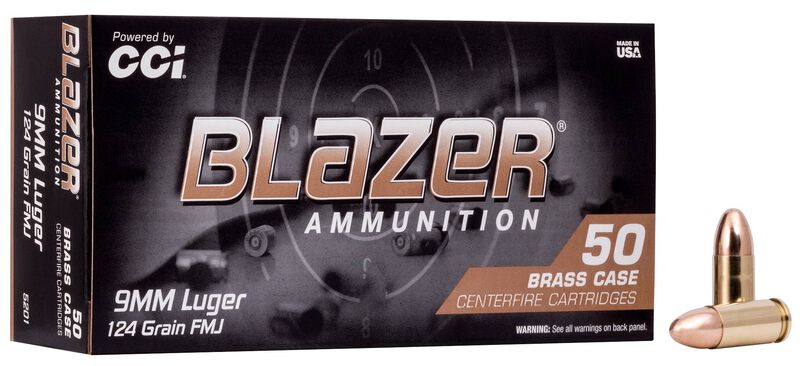
You are planning a long day of pistol practice, a few hundred rounds or more, and you want ammunition that runs every time without costing a fortune. Several boxes look almost alike, and one name keeps showing up: CCI Blazer Brass. Is it as good as the more expensive boxes, or will it jam halfway through a class?
By the end you should be able to tell whether it fits your pistol and your purpose, and when something else makes more sense.
For practice, Blazer Brass is one of the best choices for most shooters: brass-cased, reloadable, standard-pressure ammunition with CCI's reliable primers, in the same tier as Federal American Eagle and Winchester White Box. Among those, buy whichever runs reliably in your pistol and costs least. For carry, the newer Blazer Brass HP is a reasonable budget hollow point, but if you can afford it, carry a proven duty load such as Speer Gold Dot or Federal HST and practice with Blazer Brass of the same bullet weight.
What Blazer Brass is and where it fits among range ammo
Blazer Brass is CCI's value-focused, brass-cased centerfire handgun line. You will see it in big-box stores, on local gun shop shelves and at training classes, because reliability, price and reloadable brass all line up in one box. You are not forced to choose between cheap and unreliable or reliable and expensive. Here is what the line offers.
- Brass cases, Boxer-primed, reloadable
- FMJ-heavy lineup with a growing JHP option
- Made to SAAMI specs, ISO-certified quality systems
- Built for everyday training, now reaching budget self-defense
Two terms need a plain definition. Boxer-primed means the primer is a self-contained cup with a single flash hole, the same basic format as most mainstream U.S. ammunition, so reloaders can reuse the case. SAAMI is the industry group that publishes standards for pressures and dimensions, and the ISO-certified quality systems mean pressures, dimensions and velocities are held to those standards under formal quality control. The brass case and the standards matter most to you, because together they give you reloadable brass and a round that behaves like a normal load of its caliber.
If you know the big domestic budget and training lines, such as Federal American Eagle, Winchester White Box, Remington UMC and PMC Bronze, Blazer Brass sits in that same tier. It adds CCI's primer reputation and a long-standing focus on reliability and reloadable cases. Our guide to choosing between those range ammunitions puts them side by side.
Brass or aluminum: Choosing the right Blazer
"Blazer" is a family name, not one product. Blazer Aluminum is the original line, with aluminum cases that are not reloadable and are aimed at maximum cost savings. Blazer Brass has the same general economy idea but upgrades to brass cases, for shooters who reload, prefer a more traditional case material, or want slightly more consistent performance and feeding.
| Feature | Blazer Brass | Blazer Aluminum |
|---|---|---|
| Case material | Brass | Aluminum, cheaper to make and slightly lighter |
| Reloading | Reloadable with standard Boxer primers and pockets | Not intended for reloading |
| In the gun | More elastic, so it expands and contracts in the chamber better, often giving smoother extraction | Can be more finicky in certain extractors or tight chambers |
| Under repeated use | Typically holds up better to repeated chambering and ejection cycles in training classes | Aimed at the lowest cost rather than long wear |
The "In the gun" row is the one to understand. When a round fires, the case swells against the chamber wall to seal it, then has to let go so the extractor can pull it out, and a more elastic metal like brass does that more smoothly. If you do not reload and want the absolute lowest cost, Blazer Aluminum can make sense. If you want brass you can reload, or you simply prefer a case that behaves like normal pistol brass, Blazer Brass is the logical step up.
Common mistake: Mixing up Blazer Brass and Blazer Aluminum because the names are so close. Read the box before you buy, especially if you reload, since the aluminum cases are not intended for it.
What is inside the box: Primer, bullet and the hollow-point option
The primer is the spark that starts everything. Blazer Brass uses CCI centerfire primers, tuned for reliable ignition and clean burn, and CCI has a long reputation for consistent, non-corrosive primers. The case is built to SAAMI dimensions under ISO-certified quality control, which aims at consistent case length, wall thickness and primer pocket dimensions.
Most Blazer Brass is FMJ, or full metal jacket, a bullet with a lead core covered by a metal jacket that does not expand on impact. That makes it a predictable training bullet. It is typically a standard round-nose design, sometimes with a protected base, where the lead base is fully covered by jacket. That reduces lead exposure in ports and barrels and helps keep bases more uniform. Our article on FMJ and TMJ bullets explains the full-jacket family in more detail.
The newer Blazer Brass HP line, introduced in 2025, uses a JHP, a jacketed hollow point bullet designed for reliable expansion. It is intended as a multipurpose cartridge, affordable enough to train with yet capable enough for self-defense. At launch it was available in 9mm Luger, .40 S&W, 10mm Auto and .45 Auto. Blazer Brass is not trying to reinvent bullet design here. It leans on simple, proven FMJ and JHP layouts and pairs them with good brass and primers. For a wider look at the bullet choices, see understanding pistol bullet types.
Choosing a caliber and bullet weight
CCI's current Blazer Brass handgun catalog covers most of the mainstream semi-auto calibers, plus .38 Special and .357 Magnum for revolvers. Within a caliber, bullet weight is the choice that changes how the load feels. Heavier bullets generally leave the barrel more slowly, and the recoil tends to feel like a push instead of a snap. You can see that in the 9mm rows, where weight climbs from 115 to 147 grains while velocity falls from about 1145 to 950 fps.
| Caliber | Load | Velocity | What to know |
|---|---|---|---|
| 9mm Luger | 115 gr FMJ | 1145 fps | Classic 9mm training load, standard pressure |
| 9mm Luger | 124 gr FMJ | 1090 fps | Heavier, slightly softer-feeling recoil |
| 9mm Luger | 147 gr FMJ | 950 fps | Subsonic in many setups, mild recoil, softer report |
| 9mm Luger | 115 gr JHP (Blazer Brass HP) | 1145 fps | Self-defense and training with the same round |
| .380 Auto | 95 gr FMJ | About 945 fps | Straightforward training load for .380 pistols |
| .38 Special | 125 gr FMJ | 865 fps | Revolver training |
| .357 Magnum | 158 gr JHP | 1150 fps | Intended primarily for target and field use, though capable of serious defensive work |
| .40 S&W | 165 gr FMJ | About 1050 fps | A bit more velocity and snap |
| .40 S&W | 180 gr FMJ | About 985 fps | Heavier push and deeper penetration |
| .40 S&W | 180 gr JHP (Blazer Brass HP) | Around 1015 fps | Marketed as a multipurpose defense and training option |
| .45 ACP | 230 gr FMJ | About 830 fps | Textbook .45 ball round |
| .45 ACP | 230 gr JHP (Blazer Brass HP) | Around 850 fps from a 5" barrel | Tuned for controlled expansion at standard .45 velocities |
| 10mm Auto | 180 gr FMJ | About 1200 fps | A solid, full-power-ish 10mm trainer |
| 10mm Auto | 180 gr JHP (Blazer Brass HP) | About 1175 fps from a 5" test barrel (CCI) | Tailored for defensive and training roles |
The numbers are catalog and test figures, and your own velocities will vary with barrel length, so check the box for the exact load. The 9mm rows matter most, because 9mm is where Blazer Brass is especially visible. The 115 gr FMJ is the standard practice load, with about 335 ft-lbs of energy from test barrels and a wide reputation as reliable, standard-pressure ammunition. Move to the 124 gr for slightly softer recoil, or the 147 gr for mild recoil and a softer report. The .380 load suits small carry pistols where recoil and cost matter, and the .38 Special and .357 Magnum let revolver shooters stay in the brand, from snub .38s to full-size .357s.
Performance in use: Pressure, accuracy, reliability and cleanliness
Blazer Brass loads are standard pressure unless otherwise marked, and they sit squarely in the normal range for their caliber. The 9mm 115 gr FMJ at about 1145 fps is nearly dead center for practice ammunition, and the .45 ACP 230 gr FMJ at about 830 fps is the classic GI ball speed. Recoil, point of impact (where the bullet lands relative to your sights) and slide cycling will feel very similar to other normal loads of the same bullet weight, which is what you want in training.
Blazer Brass is not match ammunition, but it is built to be accurate enough for its purpose. How tight it groups depends on your pistol and on you, so measure it yourself rather than relying on someone else's number. Reviewers who have shot large quantities of the 9mm generally find it accurate enough for classes, drills and IDPA or USPSA club matches. You will not win a bullseye national championship on it alone, but you will see your mistakes, call your shots and track your improvement, especially compared with ultra-cheap or inconsistent imports.
Reliability is where Blazer Brass has made its name. SAAMI-spec ammunition, ISO-certified production and CCI primers are all aimed at keeping misfires and out-of-spec rounds rare. Brass cases and standard FMJ and JHP profiles feed well in most modern semi-autos, and third-party reviews and user reports consistently praise it for low malfunction rates. In a multi-day pistol class, reliability and consistency matter more than small differences in group size.
Cleanliness is solid rather than spectacular. The powders and primers burn clean but are not branded as "ultra-clean" or "low-flash." Most shooters find it cleaner than the cheapest foreign ammunition and perfectly fine for normal cleaning intervals, such as after a range day or a class.
Key idea: Range ammunition has a different job than match or defensive ammunition. Its job is to run reliably and affordably so you can afford more repetitions, and Blazer Brass is built for exactly that.
The fair test of any range load is your own pistol. Shoot it side by side with one of its neighbors at the same distance, note any malfunctions and the group size, and see how dirty the gun gets. Domestic brass-cased lines usually run and group so closely that price and availability decide.
The Blazer Brass HP line: Training and defense with one load
The hollow-point line changes what Blazer Brass can be. Before it, Blazer Brass was range ammunition that happened to be brass-cased. Now it is also a budget-conscious self-defense option. The stated design goal is a quality multipurpose cartridge that is affordable enough to train and defend with the same round. It comes in 9mm 115 gr JHP, .40 S&W 180 gr JHP, 10mm 180 gr JHP and .45 ACP 230 gr JHP, with reloadable brass, clean CCI primers and a bullet built for reliable expansion at typical handgun velocities.
Here is why that matters. Many shooters practice with cheap FMJ and carry a pricier hollow point, so their practice differs from the load they actually trust. With the HP line you can shoot hundreds of rounds of your actual defensive bullet each year without emptying your wallet. Premium lines such as Speer Gold Dot, Federal HST and Hornady Critical Duty may still offer better barrier performance, and they cost more, while Blazer Brass HP is engineered as a very cost-effective choice. Our guide to premium defensive ammunition explains what those lines add. Whatever you carry, confirm that your own pistol runs it reliably.
How Blazer Brass compares with other budget ammunition
To decide whether Blazer Brass is your range ammunition, compare it with its neighbors. Federal American Eagle and Winchester White Box are brass-cased, Boxer-primed, SAAMI-spec and aimed at training, range and practice, just like Blazer Brass. Blazer Brass often gets praise for very solid primer reliability, which is CCI's specialty, along with competitive pricing and frequent availability. On the range the differences are small, and many shooters just pick whichever is cheapest that day and shoots well in their gun. Blazer Brass does stand out if you are a CCI, Speer or Federal fan who wants to stay within that family. To compare, read about Federal American Eagle and Winchester White Box.
Imported lines are a different trade.
- S&B and PMC Bronze. Both are solid brass-cased options that sometimes undercut domestic prices. See PMC Bronze in detail.
- Steel-cased and ultra-cheap imports (such as Tula and Wolf). They may be cheaper, but they often are not reloadable, can be dirtier or harder on extractors and chambers, and may show more quality-control variance in velocity and accuracy.
The trade is simple. Blazer Brass asks you to pay a bit more than rock-bottom and gives you domestic production, reloadable brass and more predictable performance.
Who Blazer Brass suits, and when to choose something else
Blazer Brass is designed for the high-volume shooter. If you are running 300 to 1,000 rounds in a weekend class, you need ammunition that simply works, and this is that use case. It also suits new shooters, who benefit from consistent, predictable ammunition so they can focus on fundamentals instead of diagnosing bad ammunition. Reloaders get cheap shooting now and brass for later, and budget-minded self-defense users can train and carry the same JHP with the HP line. Look elsewhere in these three cases.
- You are chasing match-level performance. For precision pistol or high-level competition, move to specialty loads or handloads tuned to your gun.
- You want the best defensive barrier performance. Duty-proven lines such as Speer Gold Dot, Federal HST and Hornady Critical Duty are optimized for FBI protocol and barrier performance. They cost more, but they are engineered for that edge case.
- You do not need reloadability and want rock-bottom cost. Blazer Aluminum or certain steel-cased imports may save a few more cents per round, at the cost of reloadability and, sometimes, reliability or cleanliness.
Putting it together
The domestic brass-cased practice lines sit in the same tier, so the cheapest one that runs in your gun is a sensible choice. Budget ammunition can let you down, though, which is why the cheapest imports and steel cases come with more caveats. Blazer Brass sits where most practice should happen: Standard-pressure, reloadable brass from a maker known for primers, at a price that lets you shoot often. Use it for volume, test it against a neighbor in your own pistol, reload the brass if you reload, and if you carry a hollow point, decide whether practicing with the Blazer Brass HP or carrying a premium duty load matters more to you, then prove whichever you choose in your own gun.
Check your understanding
Try answering these before you open the answer. If you can decide what to do and explain why, you have it.
1. You reload your own ammunition and shoot often. Why is Blazer Brass a better fit than Blazer Aluminum, even though aluminum may cost less?
Blazer Brass cases are reloadable with standard Boxer primers and pockets, while aluminum cases are not intended for reloading. Brass is also more elastic, so it often extracts more smoothly and typically holds up better to repeated cycles.
2. Your 9mm groups are larger than you hoped with Blazer Brass. How do you find out whether the ammunition is the problem?
Shoot the same pistol from a rest with one or two other loads on the same day. If every load groups about the same, the limit is you or the pistol, not the ammunition. If one load is clearly better, you have found what your pistol prefers.
3. You carry Federal HST in your 9mm, but at its price you shoot only one box of it a year. Should you switch your carry load to Blazer Brass HP so you can practice with it?
It's a real trade. Blazer Brass HP lets you shoot hundreds of rounds of your carry bullet each year and confirm it runs in your pistol. HST is a duty-proven load with better barrier performance. A sound middle path is to keep carrying HST, practice with Blazer Brass FMJ of the same weight, and fire enough HST to be sure it feeds and hits where you aim. If HST's cost means you'd otherwise barely practice, the Blazer Brass HP is a reasonable choice.
4. Blazer Brass, American Eagle and White Box are all brass-cased, Boxer-primed and SAAMI-spec. How would you choose among them?
The differences on the range are small, so test them in your own pistol and favor the one that runs without malfunctions, groups well and is cheapest that day.
Where to go next
You can find CCI Blazer Brass on our website in 9mm, .380 Auto, .38 Special, .357 Magnum, .40 S&W, 10mm and .45 Auto, including the hollow-point loads, and anything listed there can be ordered if it isn't in stock.
For a head-to-head look at the budget field, read how to choose between American Eagle, Winchester White Box, Remington UMC, PMC Bronze and Blazer Brass. If the bullet types in the table were new to you, understanding pistol bullet types is the logical next step. If the HP line has you thinking about carry ammunition, selecting personal and home defense ammunition covers what to weigh. And ammunition quality, from cheap to match grade helps you see where range ammunition fits on the larger scale.
If this article helped you, we invite you to sign up for email notifications of new blog articles.