
What Goes into Cartridge Design? Understanding Powder, Bullet Weight, Primer, and More
Joseph McLain Nov 07, 2026
Two boxes of rifle ammunition: one is marked 55 grain, the other 140 grain. One has a brass case, a cheaper box has a steel case, and a third mentions a powder that holds up in hot and cold weather. The prices differ, and nobody has told you what you're paying for. Is ammunition just ammunition, or does every component matter?
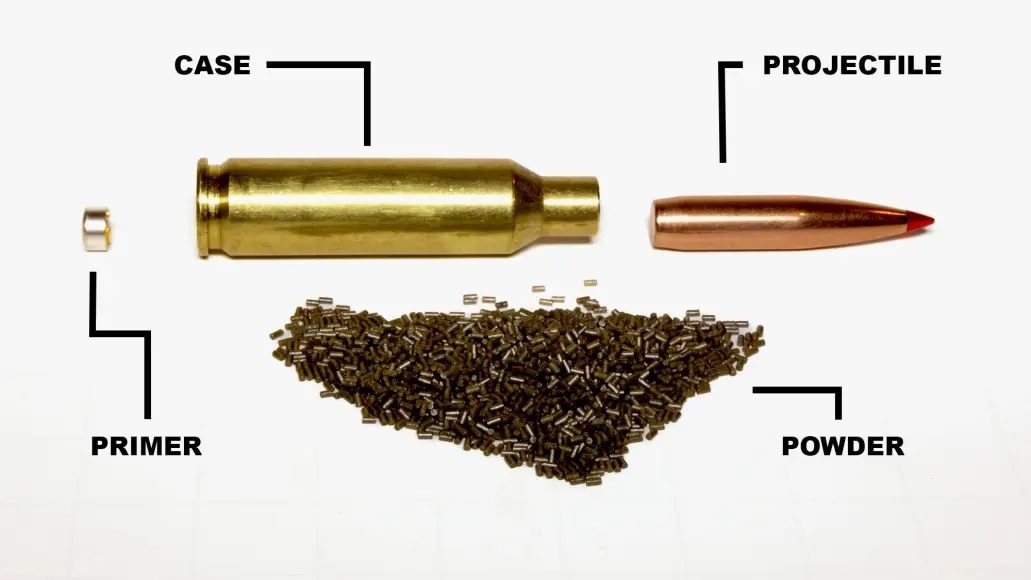
Taking a cartridge apart one component at a time, powder, bullet, primer and case, shows what each part does and why it was chosen. By the end you should be able to read a box of ammunition the way a designer would, match the parts to what you want to do and explain your choice.
A cartridge is a system: How the four parts work together
A cartridge looks like one object, but it is really four parts working in a chain, and the chain only works if every link does its job. Here is what happens in the fraction of a second after you press the trigger.
- The firing pin strikes the primer, a small component at the base of the cartridge, and it ignites.
- The primer's flash lights the powder, also called the propellant, inside the case.
- The burning powder makes expanding gas, and the resulting pressure drives the bullet down the barrel.
- The case holds everything together. A brass case also expands slightly and seals the chamber, so the pressure pushes the bullet forward instead of leaking backward.
Because each part depends on the others, changing one changes the job of the rest. A heavier bullet calls for a different powder than a light one, and a longer barrel changes which powder works best. That is why cartridge design is better described as a recipe than as a parts list. We will walk through the ingredients one at a time, then look at how three popular cartridges combine them, so the label on a box starts to tell you something.
Key idea: Every component affects accuracy, velocity, terminal performance and reliability, and each one has to be matched to the others and to the firearm. The best cartridge for you is the one whose parts fit your purpose.
Powder selection: Matching the burn rate to the barrel
Powder is the fuel behind the bullet, and it directly influences the bullet's velocity, energy and consistency. Different powders burn at different rates, and that burn rate has to be matched to your firearm's barrel length and to how you plan to use it.
Think of the barrel as a running track. A sprinter puts everything into a short, explosive dash, while a distance runner paces the effort so there is still push left late in the race. Fast-burning powder behaves like the sprinter and slow-burning powder behaves like the distance runner. The powder has to do its work while the bullet is still in the barrel, so the track length decides which runner you want.
| Powder type | Best matched to | How it burns | What it does for you |
|---|---|---|---|
| Fast-burning | Shorter barrels, such as pistols and some carbines | Ignites quickly and gives a rapid, high-pressure impulse with a sharp pressure curve | Sends the bullet off at high speed over a short distance, when there is little barrel length for a gradual burn |
| Slow-burning | Longer barrels, such as rifles and long-range precision platforms | Gives a controlled, gradual burn that sustains pressure over a longer distance | Helps maintain velocity and consistency, which are crucial for long-range accuracy |
Start with your barrel. A pistol gives the powder only a few inches to work with, so it needs a powder that delivers its push quickly. A long rifle barrel gives the powder room to keep pushing, so a slower powder can keep adding speed and keep the shot-to-shot results steady. A mismatch in either direction wastes the barrel you have.
What powder changes in use
- Velocity. The type and amount of powder set the speed at which the bullet leaves the barrel. Faster-burning powders produce higher velocities in short barrels, while slower powders can reach high velocities in long barrels.
- Recoil and pressure. Burn rate affects chamber pressure, and higher pressures generally mean higher velocities and more recoil. A well-matched powder keeps pressure within safe limits while delivering the cartridge's intended performance.
- Temperature sensitivity. Some powders are more sensitive to ambient temperature changes than others. Powders designed for extreme conditions help a load perform consistently in hot or cold weather.
Velocity and pressure always travel together, so you will see them in every load. Temperature sensitivity matters most if you shoot in more than one season, such as sighting in on a warm September afternoon and hunting on a frosty November morning. A powder that is less sensitive to temperature gives you less reason to worry that the rifle will behave differently on those two days.
Two manufacturers show how this plays out in real products. Hornady uses proprietary powders in its Superformance ammunition that can increase muzzle velocity by up to 200 fps without a corresponding increase in recoil, which is particularly beneficial for long-range hunting. Federal emphasizes temperature stability in its Premium lines, so the powders perform consistently across a wide range of environmental conditions. That is key for shooters who need reliable performance regardless of weather.
Bullet weight: Balancing velocity and energy
The bullet is the part that actually meets the target, and its weight, measured in grains, shapes nearly everything about how a cartridge behaves. Weight influences muzzle velocity, trajectory (the curved path the bullet flies), and what the bullet does on impact. To feel the trade-off, imagine throwing a wiffle ball and a baseball into the same breeze with the same effort. The light ball leaves your hand quickly but the wind pushes it around, while the heavy ball is harder to blow off course and carries more punch when it lands.
| Category | Weight range | Best for | Example cartridge |
|---|---|---|---|
| Light | 55 to 100 grains | Varmint hunting, plinking and short-range target shooting | .223 Remington with 55-grain bullets, used for varmint hunting and target shooting because of their high speed and precision |
| Medium | 100 to 180 grains | General hunting and precision target shooting | 6.5 Creedmoor, often 120 to 140 grains, popular for long-range performance and accuracy in hunting and competition |
| Heavy | 180+ grains | Large game hunting and long-range precision shooting | .308 Winchester, commonly around 180 grains for larger game, with the balance of velocity and energy needed for ethical kills |
Treat the weight ranges as guides rather than walls. They overlap at the edges, and the .308 Winchester sits right where medium meets heavy. What the table really shows is a slide from speed toward energy and stability as the bullets get heavier.
Here is the cause and effect behind that slide. Lighter bullets generally leave the muzzle faster, which gives a flatter trajectory at short distances, and that is why they suit small game and pests, where speed and precision matter more than raw energy. The cost is that they are more affected by wind and can lose velocity faster over distance. Heavier bullets, when properly designed, deliver more kinetic energy on impact, which means deeper penetration and greater effectiveness on larger game, and they are less affected by wind drift, so they are more stable at long range. They tend to show a more pronounced drop, in part because they are generally launched more slowly, but drop is predictable and can be corrected with your scope. Wind is the harder thing to read, which is one reason heavier bullets are favored where wind drift and drop must be kept in check.
Common mistake: Assuming that heavier is always better. A heavy bullet is built for large game and long distance. For varmint or small-game hunting, lighter bullets work best, and for medium to large game or long-range shooting, medium to heavy bullets provide the energy and stability you need.
Start with what you are shooting and how far away it is, then pick the weight category that fits. If you want to go further, our guide to bullet weight in rifle rounds covers how weight changes performance, and the heavier you go, the more it matters that your barrel can stabilize the bullet.
Primer: The small part that lights everything
The primer is small, but nothing happens without it. When the firing pin strikes the primer, it ignites the powder charge and sets the whole cartridge in motion. Because every shot starts here, the primer plays a major role in how consistent and reliable a cartridge is.
Centerfire primers come in two main designs, named Boxer and Berdan. The difference lies in the flash hole, the small opening that carries the primer's flash into the powder.
| Feature | Boxer primers | Berdan primers |
|---|---|---|
| Flash holes | A single flash hole | Typically two flash holes |
| Where you find them | The most common type in modern ammunition, widely used in civilian ammunition, particularly match-grade and self-defense rounds | Often found in military surplus ammunition |
| Reloading | Simpler to reload and inspect | More challenging to reload |
For most readers, the practical meaning is this. If you ever want to reload, Boxer-primed cases are the ones to look for, because they are easier to work with and inspect. Berdan primers are reliable, but they are less popular in the civilian market because they are hard to reload.
What matters most for performance is that the primer behaves the same way every time. A consistent primer ensures uniform ignition, which directly affects muzzle velocity and shot-to-shot consistency. Imagine trying to light a campfire with a match that sometimes flares and sometimes only sputters. The fire never starts the same way twice, and neither does the powder. The size and sensitivity of the primer also influence how quickly the powder ignites and how pressure builds in the chamber, so reliable primers are essential for achieving the expected performance and for maintaining safety.
Federal Gold Medal Match primers are designed for high sensitivity and consistency, which makes them a top choice among competitive shooters (see our guide to Federal Gold Medal ammunition for how that precision shows up in the finished round). CCI primers are known for their reliability under various environmental conditions and are widely used in both hunting and target shooting ammunition.
Safety: If you reload, always follow published load data from a reputable source, and never guess at powder or primer combinations. Primer and powder have to be matched, and pressure is the thing you cannot see.
Case design: The part that holds it all together
The case holds the primer, powder and bullet together, and it is critical for safe and efficient operation. Cases are typically made from brass, steel or aluminum, and each material brings its own advantages and limits.
| Material | Best for | Advantages | Limitations |
|---|---|---|---|
| Brass | Reloading and general shooting | Durable and can be reloaded multiple times; expands slightly on firing to seal the chamber, which improves efficiency and accuracy | Costs more than steel |
| Steel | Plinking and budget shooting | Less expensive than brass | Generally not reloadable |
| Aluminum | Lightweight ammunition | Lighter and highly resistant to corrosion | Typically not reloadable |
Think about what you do with the empties after a range day. Reloadable brass is popular with shooters who want to customize their loads and save money over time, because the case can be used again and again. Steel is often used in military surplus or budget-friendly ammunition where cost is the main concern, but you generally can't reload it. Aluminum is lighter and resists corrosion, and it is typically not reloadable either. It is found in some defensive ammunition for semi-automatic pistols, where reduced weight and corrosion resistance are valued.
Case design also shapes performance in three ways.
- Internal volume. The space inside the case limits how much powder it can hold, which influences chamber pressure and muzzle velocity.
- Extraction and ejection. A well-designed case comes out of the chamber and out of the gun reliably, which is crucial for consistency, especially in semi-automatic firearms.
- Durability. The material and construction decide how well the case withstands repeated firing and, if applicable, reloading.
Internal volume is the one people overlook. A bigger case can hold more powder, and more powder can mean more pressure and more velocity, which is part of why different cartridges behave so differently even when they use the same bullet diameter. For most shooters, the choice comes down to cost versus reuse. Choose brass if you will reload or want general-purpose performance, and choose steel only if the lowest price matters most and you do not plan to reload.
How Federal and Hornady tune the whole cartridge
Top manufacturers such as Federal and Hornady invest heavily in research and development, and their work shows how the four parts are tuned together instead of one at a time. Their insights can help explain why certain cartridges perform better under specific conditions.
- Federal advanced testing. Federal uses state-of-the-art ballistics testing so its cartridges perform consistently in various environmental conditions, and its focus on temperature stability means they are engineered to work whether it is hot, cold, or somewhere in between.
- Federal Trophy Bonded Tip. This signature line combines advanced bullet technology with high-quality powder and brass to deliver deep penetration and excellent weight retention, which is ideal for big-game hunting.
- Hornady bullet designs. Hornady has pushed bullet technology with the ELD-X and FTX® lines, designed for exceptional accuracy and terminal performance.
- Hornady consistency. The Match and Critical Defense lines are highly regarded for consistency, which makes them favorites among competitive shooters and self-defense users alike.
- Hornady specialized powders. Proprietary powders are engineered for specific cartridges, helping optimize performance by matching the burn rate to the bullet weight and barrel length.
Notice that each line is built around a purpose. Trophy Bonded Tip points the whole cartridge toward penetration and weight retention on big game, the Match and Critical Defense lines point it toward consistency, and Hornady's specialized powders tie the first section of this article, burn rate, directly to bullet weight and barrel length. When you read a product line name, ask which parts of the recipe the maker is tuning and whether that matches what you want from the cartridge.
Reading the recipe: Three cartridges as worked examples
Now let us put the ingredients together. These three cartridges show how powder, bullet weight and purpose line up.
| Cartridge | Typical bullet and powder | Best use and key features |
|---|---|---|
| .308 Winchester | Medium to heavy bullets, 150 to 180 grains | Hunting and long-range shooting. Offers a balance of speed and energy with excellent terminal ballistics, so it is versatile for medium to large game and for precision target shooting. |
| 5.56mm NATO / .223 Remington | Light bullets, 55 to 77 grains, with fast-burning powder | Varmint hunting, target shooting and military applications. Designed for high velocity and a flat trajectory, which is ideal for small targets and fast-moving varmints. |
| 6.5 Creedmoor | Bullet weights typically 120 to 140 grains, with slow-burning powder | Precision shooting and long-range hunting. Maximizes accuracy by maintaining velocity over long distances, and its excellent ballistic coefficient and reduced wind drift make it a top choice for competitive shooters and hunters alike. |
Read each row as a small argument. The .223 Remington pairs light bullets with fast-burning powder to get speed and a flat path, which suits a small, quick target. The 6.5 Creedmoor pairs mid-weight bullets with slow-burning powder to hold its velocity downrange. The ballistic coefficient, or BC, is a measure of how well a bullet slips through the air, and a high BC is why wind pushes this bullet around less. The .308 Winchester sits in the middle, with enough weight to carry energy and enough speed to stay versatile. You can go deeper on the first two in our articles on .308 Winchester and 7.62x51mm NATO and on 5.56 NATO and .223 Remington.
You may have noticed that the .223 is a rifle cartridge that uses fast-burning powder, while earlier we matched slow powder to rifles. That is a good reminder that burn rate is chosen for each cartridge as a whole, in relation to its case, bullet and barrel, not handed out by a single rule.
A well-designed cartridge does not just shoot well. It performs consistently, withstands real-world conditions, and gets the most from your firearm, which leads to better accuracy, improved safety and a more enjoyable day at the range.
Reading a box like a designer
Any box of ammunition can be read as a recipe. The bullet weight on the label sorts it into light, medium or heavy in the table above, and the product line name and bullet description reveal the purpose the maker had in mind, such as varmint, long range or big game. The case material shows too: brass is golden, steel sticks to a magnet, and aluminum is noticeably lighter in the hand. An empty fired case, never a live round, held up to a light shows the primer type: one central flash hole means Boxer, two small holes mean Berdan. When you can say what a cartridge is built for because of its powder, bullet weight, primer and case, and why it would be a poor choice for another job, you're reading it like a designer.
Putting it together
Powder, bullet, primer and case each change how a cartridge performs, and premium loads spend more on consistency and bullet design. For practice, a reliable, consistent load is enough; for hunting or precision, the bullet and consistency become worth paying for. Read the box for bullet weight and type, case material and any special powder, and choose the components that match the job you are doing.
Check your understanding
Try answering these before you open the answer. If you can decide what to do and explain why, you have it.
1. Your carbine has a 16-inch barrel, and the powder in your favorite pistol load is listed as fast-burning. Why do pistols use fast powder?
A fast-burning powder delivers its push quickly, sending the bullet off at high speed over a short distance. A short pistol barrel doesn't give a slow powder the length it needs to finish burning, so it would waste energy and flash at the muzzle.
2. A friend wants one load for varmints and elk, and says to pick the heaviest bullet available. What would you tell them?
Heavier is not always better. Lighter bullets work best for varmint or small game, because speed and precision matter more than raw energy. Medium to heavy bullets provide the energy and stability for larger game and long-range shooting. Match the bullet weight to the purpose.
3. Two loads use the same bullet and powder, but one maker advertises premium primers. Why might that matter on paper?
Every shot starts with the primer. A consistent primer gives uniform ignition, so the powder lights and pressure builds the same way each time, which keeps muzzle velocity and shot-to-shot consistency tight. Reliability matters for safety too.
4. You shoot a lot of rounds on a budget, and you also like to reload. How do brass and steel cases compare for you?
Steel is less expensive but generally not reloadable, so it only makes sense if you will not reload. Brass is durable and can be reloaded multiple times, so it saves money over time for a reloader and is the better fit for you.
5. Why can the 6.5 Creedmoor hold up better to wind at long range than the .223 Remington?
The 6.5 Creedmoor uses heavier bullets, typically 120 to 140 grains, with a slow-burning powder that helps it maintain velocity, and it has an excellent ballistic coefficient. The .223 with 55-grain bullets is built for speed and a flat path at shorter distances, and light bullets are more affected by wind.
Where to go next
To see how these components show up on a target, read how ammunition affects your accuracy, which follows the bullet from the powder burning to the group on the paper. Then try understanding bullet shapes for rifle rounds, since weight is only half of the bullet story and shape is the other half. The comparison of 6mm Creedmoor, 6.5mm Creedmoor and 6.5mm PRC shows the cartridge recipe at work in long-range rifles, and understanding ammunition quality helps you decide which of these design choices are worth paying for. Happy shooting.
If this article helped you, we invite you to sign up for email notifications of new blog articles.