
Mastering Range Ammo: How to Choose Between American Eagle, Winchester White Box, Remington UMC, PMC Bronze, and Blazer Brass
Joseph McLain Nov 07, 2026
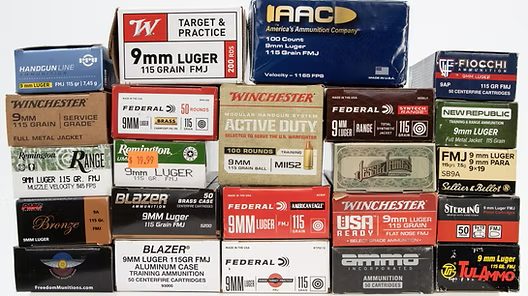
Most shooters eventually reach the point where "any cheap 9mm" stops being a satisfying answer. You start to notice that one box runs cleaner than another, that some groups better, that some feels closer to your carry load, and that some is just annoying, with random fliers, odd recoil and a dirtier gun. At that point you are ready to understand the five budget range lines that fill most ammunition shelves: Federal American Eagle, Winchester USA (the "White Box"), Remington UMC, PMC Bronze and CCI Blazer Brass. By the end of this article you should be able to explain what each line is really doing, choose two or three to test in your own gun, and run a simple comparison that tells you which one to buy by the case.
All five live in the same general price and purpose bracket. They are brass-cased, non-corrosive (the residue will not rust your barrel the way old corrosive surplus ammunition could), made to SAAMI specifications (the industry standards that keep ammunition and chambers compatible and pressures safe), and mostly loaded with FMJ bullets. FMJ means full metal jacket, a lead core wrapped in a harder metal shell that does not expand, which makes it a good fit for training and general use. But the five are not identical. Each has its own strengths, quirks and best-fit uses.
What range ammunition is actually supposed to do
Before comparing brands, it helps to decide what we are asking this ammunition to do. Range ammunition is the ammunition you learn with, so it needs to give you honest feedback. For most shooters, good range ammunition should do six things.
- Run reliably. You should not see frequent failures to fire, feed or extract in a healthy gun.
- Be consistent. Velocities that do not vary wildly keep your point of impact (POI, where the bullet hits relative to your sights) and your recoil feel predictable.
- Offer usable accuracy. Accurate enough that, from a rest, the ammunition is clearly not the reason your groups are large.
- Not be filthy. You will still clean your gun, but it should not look dipped in soot after one box.
- Be reasonably priced and widely available. You need to be able to buy enough to actually train.
- Use reloadable brass. This matters if you reload, or even if your friends do.
Not all six carry equal weight. Reliability and consistency come first, because they decide whether you can learn anything from a range trip. If a round jams or lands somewhere unexpected, you cannot tell whether the problem was you or the ammunition. Cleanliness, price and reloadable brass are valuable, but they are tiebreakers once the first two are met. All five lines aim squarely at these goals. The differences are how they get there, where they are made, and which shooters they quietly favor.
Key idea: Good practice ammunition is not the cheapest box. It is the box that behaves the same way every time, so the results you see come from you and not from the ammunition.
The big five at a glance
| Line | Maker and origin | Bullets and calibers | Typical packaging |
|---|---|---|---|
| American Eagle | Federal | FMJ in popular calibers, such as 9mm 115 gr | 50-round boxes, 100-round sleeves, 500-round cans (9mm and similar) |
| Winchester USA "White Box" | Winchester | FMJ in 9mm, .380, .40 and .45 | 50- and 100-round bulk packs, famous for 100-round "Value Packs" |
| Remington UMC | Remington (now under Remington Ammunition), made in Lonoke, Arkansas | FMJ, soft point and JHP in several handgun calibers | Bulk "Mega Pack" boxes, such as 250 or 350 rounds of 9mm |
| PMC Bronze | PMC (Precision Made Cartridges), part of Poongsan Corporation in South Korea; imported | FMJ; 9mm 115 gr FMJ is extremely popular | 500- and 1000-round cases, especially online |
| CCI Blazer Brass | CCI | Mostly FMJ; some JHP and a newer Blazer Brass HP line; 9mm, .380, .40, .45, 10mm, .38 Special, .357 Magnum and others | 50-round boxes; 500-round bulk packs |
On paper the five look alike, because they all use FMJ bullets in common handgun calibers. The real differences are in who makes them and how you tend to buy them. One comes from a premium-ammunition factory, one comes from a big-box shelf, one is an old American name, one is an import that sells mostly by the case online, and one is the brass-cased sibling of a famous economy line. Those origins shape the profiles below.
Profiles of the five lines
Federal American Eagle
American Eagle is Federal's primary target and practice line for centerfire ammunition. It is designed as value-packed training ammunition with FMJ bullets, and it is made at the same Federal plants that produce the premium lines, using the same processes and quality control. Many instructors like it partly because, when you pick an American Eagle load of the same bullet weight as your Federal defensive load, recoil and point of impact tend to be similar, so the habits you build in practice transfer. Confirm that in your own gun rather than assuming it.
Shooters report very solid reliability, which is why it is widely used in IDPA, USPSA and 3-Gun as a "default" training ammunition. Its cleanliness is middle of the road. It is not a super-clean line, but it is consistent and not obnoxiously dirty. Read more in our look at Federal American Eagle.
Winchester USA "White Box"
The White Box is Winchester's classic USA line. It is branded as high-quality, general-purpose ammunition for a wide range of handgun needs, and it uses FMJ bullets for positive functioning with no expansion, aimed at target and range shooting. Winchester's marketing emphasizes consistent accuracy for target and range work and reduced barrel fouling for easier maintenance. It is offered in 50- and 100-round bulk packs, especially popular in big-box stores.
What shooters notice first is that it is everywhere, especially in 100-round packs of 9mm, .380, .40 and .45. It generally feeds and functions well across common pistols. Some shooters have historically reported more occasional outliers, such as oddly smoky lots or less consistent primers, compared with Federal or CCI, but many shoot thousands of rounds with no issues. Notice why that reputation can arise. When a brand sells in huge volume, you hear more stories about it, good and bad. See Winchester White Box Target & Practice Ammunition for more detail.
Remington UMC
UMC stands for Union Metallic Cartridge, and it is one of the oldest ammunition brand names in the United States. Remington (now under Remington Ammunition) makes it in Lonoke, Arkansas. It uses factory-fresh brass (not remanufactured) and Remington Kleanbore primers, and it is marketed for practice, personal defense and hunting. It offers FMJ, soft point and JHP bullets in several handgun calibers and is widely described as a value-oriented, high-volume line with broad availability.
UMC feels very "normal." If you have shot generic 9mm or .45 from a range rental counter, there is a decent chance you have used it. The bulk "Mega Pack" boxes are common, and the JHP options give you a budget defensive choice without leaving the brand. It is the quiet workhorse of the group, with a long history, big green boxes and a reputation for decent performance at an honest price. Our article on Remington UMC goes deeper.
PMC Bronze
PMC stands for Precision Made Cartridges, and it is part of Poongsan Corporation in South Korea. The Bronze line is PMC's flagship commercial training ammunition. It is imported but built to U.S. specifications, SAAMI-compliant and in some cases MIL-SPEC compliant (meeting a military specification), with ISO-certified quality control. It is marketed as reliable, precise and reloadable brass-cased ammunition for range and training, using clean-burning powders and standard FMJ bullets.
In 9mm, the PMC Bronze 115 gr FMJ is often cited as one of the best values in bulk ammunition, described as clean, consistent, reliable and reloadable. Do not let the word "imported" mislead you. PMC describes its quality control as including electronic checks of every powder charge, and users commonly report low malfunction rates. Velocities tend to be moderate, neither the hottest nor the softest, and very consistent. If you shop bulk deals online, this is often the "why is this so well-reviewed for the price?" option. We cover it in PMC Bronze Ammunition In Detail.
CCI Blazer Brass
Blazer Brass is the brass-cased branch of the Blazer family, which also includes Blazer Aluminum. It is Boxer-primed and reloadable, made for shooters who want Blazer's economy but prefer brass over aluminum (aluminum cases are generally not reloaded). It comes in popular pistol calibers including 9mm, .380, .40, .45, 10mm, .38 Special and .357 Magnum. It is primarily FMJ target ammunition, though there are JHP options in some calibers and a newer Blazer Brass HP line focused on budget defensive use.
It is very often described as comparable to Federal American Eagle in feel and reliability, which makes sense given the shared corporate family. The brass is reloadable and behaves like you would expect from a domestic manufacturer, and it is SAAMI-spec and ISO-backed, widely trusted as default-class ammunition. If you like CCI's rimfire and primer reputation, Blazer Brass is their handgun equivalent, solid, predictable and range-focused. See CCI Blazer Brass Ammunition In Detail.
Comparing the five on what actually matters
Rather than asking whether Brand A beats Brand B, it is more useful to compare the lines on specific qualities. That keeps you focused on your own needs.
Reliability and quality control
All five are reliable enough for normal range work. The differences are in how much you can know about why. American Eagle is built at the same plants and with the same processes as Federal's premium ammunition, and it is commonly recommended for training classes, IDPA, USPSA and 3-Gun because it just runs. PMC Bronze is SAAMI and (for some loads) MIL-SPEC compliant, with ISO Bureau Veritas certified quality systems, and PMC says every powder charge is checked electronically. Blazer Brass is SAAMI-spec and ISO-backed with CCI primers, and reviews and range reports place it in the same reliability tier as American Eagle. Remington UMC is American-made from first-quality brass and Kleanbore primers and is generally reliable in modern handguns, and many ranges use it as their house ammunition.
Winchester White Box has a long track record and huge volume, and it is widely used by rental ranges and casual shooters. Most shooters experience reliable function, but you will occasionally hear more complaints about oddball lots than with some competitors simply because it is so common. If you value documented quality control and testing, PMC Bronze, American Eagle and Blazer Brass tend to stand out slightly.
Accuracy and consistency
For most pistols, the limiting factor is the shooter, not the ammunition. The way to find out is to shoot two loads from a rest on the same day: If they group about the same, the ammunition is doing its part and any wider scatter is a fundamentals conversation. Even so, some loads are more consistent than others.
American Eagle is often used in defensive training because, in a matching bullet weight, its recoil and POI tend to be close to Federal defensive loads. Winchester markets the White Box for consistent accuracy and reduced barrel fouling. Shooters generally report Remington UMC as accurate enough for most training. PMC Bronze, especially in 9mm 115 gr FMJ, is heavily marketed and widely reviewed as reliable and precise, with smooth cycling and clean burn. Blazer Brass is often compared directly to American Eagle, and multiple reviews note that it is clean and accurate enough for all typical training and local competition use.
If you shoot off a rest, or from a pistol-caliber carbine or lever gun, you might be able to see small differences in group size. For most pistol work, all five can outshoot the average shooter.
Cleanliness
Cleanliness matters most when you are shooting 300 to 1,000 rounds in a weekend class. American Eagle uses clean-burning powders and Federal primers, and it is marketed for realistic practice with manageable fouling. Winchester explicitly advertises reduced barrel fouling for the White Box. Kleanbore primers in Remington UMC are designed to burn cleanly, to give good value without making your gun disgusting. PMC Bronze is marketed as using clean-burning powder and producing low fouling, and many users comment positively on how clean it shoots for a budget line. Blazer Brass is widely described as reasonably clean, with brass cases that help avoid some extraction issues associated with lacquered or steel cases, and its cleanliness is comparable to American Eagle.
None of these is a filthy outlier. If we lean on manufacturer claims and common user experience, PMC Bronze, Winchester White Box and American Eagle get slightly more "clean" marketing emphasis. In practice, all five will keep a well-lubricated gun running through a class with normal cleaning.
Reloadability
All five lines are brass-cased, Boxer-primed and reloadable. A Boxer primer sits in a pocket at the base of the case with a single central flash hole, a design that is straightforward to reload. American Eagle uses standard Boxer-primed brass cases, and Winchester USA White Box uses brass cases in a line explicitly marketed as quality target and practice ammunition. Remington UMC uses factory-fresh brass with clean-shooting Kleanbore primers. PMC Bronze uses newly made reloadable brass casings that are SAAMI and MIL-SPEC compliant. Blazer Brass uses brass cases and standard Boxer primers and is explicitly sold as reloadable practice ammunition.
If you reload, pay attention to case longevity and primer pocket tightness in your own guns. Different chambers and extraction patterns can be harder on brass, but in general all five give good reloadable brass.
Availability and price behavior
Where you shop shapes what you find. American Eagle tends to be well-stocked at stores that already lean Federal-heavy, and Blazer Brass shows up heavily in shops that stock CCI, Federal and Speer. Winchester White Box is very common in big-box retail and is often the first thing newer shooters see in the ammunition aisle. Remington UMC's availability rises and falls a bit as Remington's production ramps and stabilizes after its restructuring, but it remains a standard offering. PMC Bronze is extremely popular online, often aggressively priced.
On price, all five move with the market. During normal times PMC Bronze, Blazer Brass, UMC and White Box sell in very similar ranges, with American Eagle sometimes a bit higher but often close, especially in bulk. The practical lesson is that price rarely separates these lines for long. What you can buy consistently, near you, in the quantity you need, is usually the better tiebreaker.
How to choose instead of just chasing the cheapest box
Now for the important part. Here is a five-step method to turn all of that information into a decision.
Step 1: Define your mission
Ask yourself three questions. What guns will you shoot, such as a compact 9mm carry pistol, a full-size steel 1911 or a pistol-caliber carbine? What is the role, whether casual plinking, structured training, classes or local matches? And do you reload? If you do, case quality and headstamp consistency matter more. Here are three example missions to compare against your own.
- "I shoot a Glock 19 and want ammunition for defensive pistol classes and IDPA."
- "I run a 9mm PCC and care a lot about clean burning and consistent chronograph data."
- "I am taking my first 2-day class and just need 1,000 rounds of something that works."
Each mission points to a different priority. The first values feel-alike recoil, the second values velocity consistency, and the third values reliability in volume.
Step 2: Lock in bullet weight and pressure level
For range work, especially with handguns, it often makes sense to match or approximate your carry load's bullet weight so recoil and POI are similar. If you shoot matches with a power factor requirement, such as USPSA, pick a load that safely makes power factor in your gun and then stick with it. Power factor is a scoring threshold that combines bullet weight and velocity.
Step 3: Short-list based on availability and reputation
Given what is usually on the shelf, use these "if this, then that" rules to pick candidates.
- If your local shelves are Federal and CCI heavy, try American Eagle and Blazer Brass first.
- If your local store is Winchester-centric or big-box, try Winchester White Box and UMC.
- If you buy online in bulk, PMC Bronze often offers one of the best cost-versus-performance balances, with the others right behind it depending on sales.
Do not overthink this step. You are simply picking two or three candidates to test.
Step 4: Compare them fairly in your own gun
Judging ammunition by "it felt fine" is a common mistake, because feelings fade. A fair comparison keeps everything the same except the ammunition: the same gun, the same drill, the same day, with eye and ear protection on and the muzzle downrange. A hundred rounds or so of each load through your main gun shows you more than a single box. What tells the loads apart is malfunctions, group size from a rest at 15 to 25 yards, where each load hits compared with your carry or match load, how the recoil feels, and how dirty the gun gets. If you have a chronograph, a device that measures bullet speed, the standard deviation (SD, how much speeds scatter around the average) and extreme spread (ES, the gap between the fastest and slowest shot) over ten shots show consistency better than the average speed does.
Here is what the results mean. If one load malfunctions and the others do not, that is a strike against it in that gun, even though it might be perfectly fine in another. If one load consistently groups tighter and has a lower SD, that is a good sign of better consistency. If one load is noticeably dirtier but also significantly cheaper, you may accept that trade-off for casual practice days and reserve the cleaner load for classes. Very often you will discover that your pistol clearly prefers one brand and weight, not because it is better on paper, but because it works well with your specific barrel, chamber and recoil system.
Step 5: Match the line to your use
Here is how each line often works out in practice.
- American Eagle. It is great for defensive training when you carry Federal defensive ammunition and want matching recoil and POI, and it is a solid choice for competition practice where reliability and familiarity are key.
- Winchester White Box. It is often the most convenient local option in 100-round packs, and it works fine for general range use, new shooters and "let's burn some ammo" days.
- Remington UMC. It is attractive for bulk-pack buyers and those who like American-made, long-running brands, and it is nice if you want FMJ for training with the option to stay in UMC for a JHP budget defensive load.
- PMC Bronze. It is a very strong choice for bulk online orders, especially in 9mm, where it has a standout reputation for cleanliness and consistency at a good price, and a good candidate if you are chronograph-oriented or run a PCC.
- Blazer Brass. It is excellent for classes and high-round-count training, with domestic manufacturing, reloadable brass and CCI primer reliability, and a nice pairing if you already use CCI rimfire or primers.
Notice that each recommendation is tied to a situation, not a ranking. In many cases the right answer is a simple one.
Good practice: Pick one brand that your gun loves, then stock deep in that exact load. Consistency of ammunition over time is often more valuable than squeezing out a tiny benefit by switching brands constantly.
Special cases where the details matter more
Indoor ranges and ventilation. If you shoot indoors a lot and the range is not well ventilated, favor loads marketed for clean-burning powder and primers. PMC Bronze specifically highlights clean burning, and American Eagle and Remington UMC also call out clean or "Kleanbore" components. No mainstream line here is lead-free by default; besides the exposed lead at an FMJ's base, most standard primers contain lead compounds. The cleaner-burning ones can reduce total soot over a long session, but ventilation matters more. Washing your hands after shooting and cleaning is a sensible habit with any of them.
Suppressed pistols and PCCs. For suppressed setups, especially pistol-caliber carbines, look for 147 gr 9mm FMJ options, which are often subsonic (slower than the speed of sound), where a line offers them. Pay attention to clean powder, because PMC Bronze and some American Eagle loads can shine here. Suppression adds its own dirty blowback, so you will clean more often regardless.
Training that mirrors defense. If your goal is to train with something that behaves like your defensive ammunition, matching the bullet weight of your carry load is the simplest way to get similar recoil and point of impact. Blazer Brass HP, if you use it, is built on the idea of training and defending with the same JHP at a value price. Otherwise, matching bullet weight across any of these brands is a practical compromise.
Putting it together
For the reasonably experienced shooter, the question is less "which brand is best?" and more three practical ones. What am I doing with this ammunition? What does my gun like? And can I get a lot of it, consistently, at a fair price?
Once you have done a simple side-by-side test in your own gun, you will usually find one load that just works better for you. Buy that one in bulk, keep a record of your sight settings if you run an optic, and let your ammunition choice become the stable part of your training instead of a constant variable. That is when these brands stop being names on a shelf and start being tools you are using on purpose.
Check your understanding
Try answering these before you open the answer. If you can decide what to do and explain why, you have it.
1. A box of a little-known brand is a few dollars cheaper than American Eagle, but two rounds in your first box failed to fire. Is it still the better deal for practice?
No. Practice only works if the ammunition gives you honest feedback. When a round fails or lands somewhere unexpected, you can't tell whether you or the ammunition caused it. Reliability and consistency come first, and price is a tiebreaker only among loads that already run well.
2. You carry a Federal 9mm defensive load and want practice ammunition that behaves like it. Which line is the natural pair, and how do you confirm it?
American Eagle in the same bullet weight is the natural pair, since it comes from the same maker and plants. Confirm it by shooting both at the same target and checking that recoil and point of impact are close.
3. In your range test, one load malfunctions twice and the others run perfectly. What should you conclude, and what should you not conclude?
That load is a strike against it in that gun. You should not conclude it is a bad product, because it may run perfectly in another firearm.
4. Why might a lower standard deviation matter more to you than a higher average velocity?
A lower SD means shots leave the barrel at more similar speeds, which means more consistent point of impact and recoil. That predictability is what makes practice ammunition useful.
5. Your friend says White Box is unreliable because he had a bad lot, while you have shot thousands of rounds with no trouble. How can both be true?
White Box sells in huge volume, so you hear more stories about it, good and bad. Occasional outlier lots are reported, but many shooters run it for thousands of rounds without issues. Testing it in your own gun settles the question for you.
Where to go next
You can find Federal American Eagle and CCI Blazer Brass practice ammunition on our website, and anything listed there can be ordered if it isn't in stock.
If you want the bigger picture on getting the most from a day at the range, read Range Ammo: Maximizing Your Range Time with Affordable, Reliable Ammunition. To understand what separates budget ammunition from match and hunting grades, Ammunition Quality explains each tier. If you want your practice rounds to resemble your carry round, see our guide to premium defensive ammunition. And if suppressed shooting caught your eye, Choosing the Right Ammunition for Suppressors picks up where the special-cases section left off.
If this article helped you, we invite you to sign up for email notifications of new blog articles.