
A Guide to Federal's 5.56mm Ammunition: Choosing the Right Round for Your AR-15
Joseph McLain Nov 07, 2026
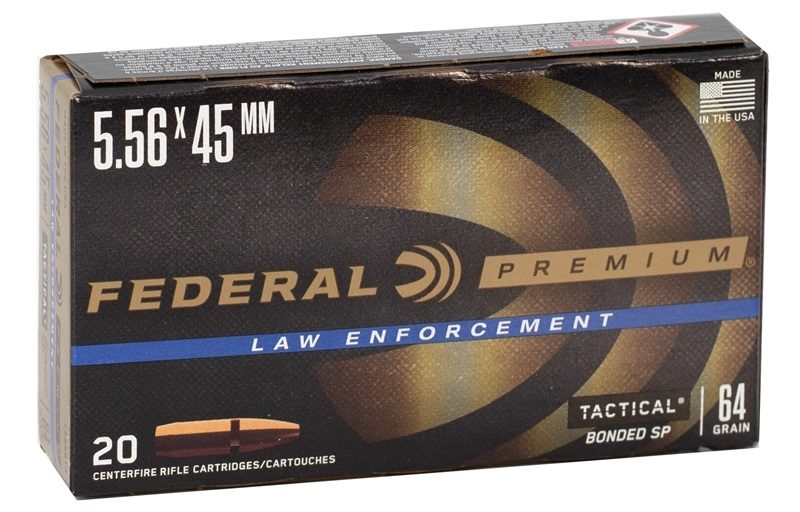
You have an AR-15 waiting at home, and the Federal 5.56 boxes all look alike: one meant for a cheap Saturday of practice, one for a match, one for deer. The names sound alike and the prices don't. Will any 5.56 do, or do you need premium ammunition to get the most from an AR?
By the end you should be able to pick the right Federal 5.56 load for a specific job, understand what terms like "bonded," "sub-MOA" and "1:8 twist" mean once you pull the trigger, and confirm the choice in your own rifle.
Federal's 5.56 lines at a glance, sorted by the job they do
Federal has been a cornerstone of the U.S. ammunition market for decades, with a history built on strong government contracts, an extensive commercial presence and a reputation for innovation (think Gold Medal, Fusion and Hydra-Shok). Its 5.56 and .223 offerings come in five main lines, each with a different balance of cost, performance and what the bullet does on impact.
- American Eagle: Budget-friendly training and plinking
- Federal Premium Law Enforcement / Tactical: Law enforcement training and specialized defensive use
- Gold Medal (Match): Precision shooting and competition
- Fusion MSR: Bonded soft points for medium game and tactical roles
- American Eagle Varmint & Predator: Rapid expansion for predators and small game
Five names are easier to sort once you notice they answer three different questions. American Eagle is about practice, meaning cost and dependable function. Gold Medal is about precision, meaning how consistent every round is. The rest are about what the bullet does on arrival. Most AR-15 owners need the first, many add the second, and the third matters if you hunt or have a defensive or duty need. Start with your job and the right line mostly picks itself.
Key idea: Manufacturing consistency decides where a round lands, and bullet construction decides what it does when it gets there. Each Federal line is a different bet on one or the other, and you should pay only for the one you need.
American Eagle, the reliable workhorse for practice
Skill comes from rounds fired, so the best practice ammunition is the kind you can afford to shoot a lot of. That is why American Eagle is the backbone of Federal's offerings for many AR-15 shooters. It is designed for the budget-conscious shooter who is building fundamentals, doing casual target practice and basic training.
American Eagle rounds carry military-style designations such as XM193 (55 grain FMJ) and XM855 (62 grain "green tip") for loads that meet 5.56 pressure specifications. A grain (gr) is the unit of bullet weight, and FMJ means full metal jacket, a bullet fully wrapped in metal and not designed to expand (see FMJ and TMJ bullets). Some of these loads are simply labeled .223, so read the designation and the cartridge marking rather than assuming. They are prized for consistent function and reloadable brass, even though they do not offer the pinpoint accuracy of the more premium lines.
What accuracy should you expect? Practice-grade accuracy: Plenty for casual shooting and "minute-of-man" plinking (hits on a target the size of a person), though not match precision, and the exact group size depends on your rifle. MOA (minute of angle) describes group size in a way that scales with distance, and one MOA is roughly one inch at 100 yards. If American Eagle groups about the same as other practice loads in your rifle, the ammunition is not what is holding you back yet. Your fundamentals are the bigger lever, and mastering the fundamentals of shooting is a good place to work on them. For more on MOA, see understanding MOA.
- Cost-effective. Great for high-volume range days.
- Reliable function. Consistent mil-spec performance makes it a dependable training choice.
- Bulk packaging. Often sold in large packs, which suits long range sessions.
- Green tip note. XM855 "green tip" bullets include a steel penetrator, so always check local range rules about steel-core restrictions.
Of these, the range-rule check is the one that can end your day early, so ask before you open the box. If you have used other economical lines, such as Winchester's White Box (see Winchester White Box) or Remington's budget offerings, you will find American Eagle similarly reliable. For a closer look at the line, read our examination of Federal American Eagle ammunition.
Common mistake: Treating a box marked .223 and a box marked 5.56 as the same thing. The two are not entirely interchangeable, so confirm the marking on your rifle's barrel and the marking on the ammunition before you shoot. Our article on 5.56 NATO and .223 Remington explains the difference, and if you are unsure, ask a qualified gunsmith.
Gold Medal Match, where you pay for consistency
Suppose you have shot a few groups with American Eagle and want to see how small your rifle can really go. That is where match ammunition comes in. Match-grade ammunition is built to remove variation, with tight tolerances and minimal velocity spread so every round performs nearly the same as the last. Federal's Gold Medal line is the premium choice for competitive shooters and anyone who demands that performance, even across a variety of AR-15 configurations.
Gold Medal is often loaded with well-known bullets such as the Sierra MatchKing (SMK) or Berger hybrids, typically in heavier weights, often 69gr or 77gr. These are designed for shooters who need sub-MOA performance (groups under about an inch at 100 yards) from long-range AR-15 setups and precision competitions. Many shooters report sub-MOA groupings in well-tuned rifles, and they report preferring it in divisions such as PRS and High Power.
Consistency matters because rounds that leave the muzzle at nearly identical speeds spend nearly identical time in the air and drop nearly identical amounts, so they land on top of each other. When speeds vary, the group stretches vertically, as we explain in how ammunition affects your accuracy. Gold Medal is also optimized for heavier loads, so it suits barrels with twist rates of 1:7 or 1:8 that can stabilize them. It is often compared with similar offerings from brands such as Hornady's Black (see Hornady BLACK ammunition) or specialized match-grade loads from Winchester. What sets Gold Medal apart is its long-standing reputation and the reliability Federal is known for in competitive circles, even though it comes at a higher price per round. For the full line, see Federal Gold Medal ammunition.
Match ammunition rewards a rifle and shooter that can already hold tight groups, because it removes the ammunition's share of the spread and leaves yours. If you are still printing 3-inch groups at 100 yards, practice will help more than a premium box. If your fundamentals are steady and you want to find out what your rifle can do, Gold Medal is the right experiment.
Hunting and field loads, and how bullets are built to behave
Hunting loads ask a different question from practice and match loads. Instead of "how tight is the group?" you ask "what will this bullet do when it arrives?" Some bullets are built to come apart quickly and transfer energy fast, which suits small animals. Others are built to hold together for deeper, controlled penetration on bigger animals. Federal has a load for each end.
Fusion MSR for deer and hogs
Fusion MSR (Modern Sporting Rifle) ammunition is designed to deliver ethical kills on medium-sized game such as deer or hogs within typical AR-15 hunting ranges, roughly 100 to 200 yards. It uses a bonded soft point. In a bonded bullet the lead core chemically fuses to the jacket, which reduces the risk of fragmentation (the core and jacket separating) on impact. Think of two layers held together with glue instead of simply stacked, because under a hard hit the glued layers stay in one piece. That promotes near-100% weight retention, which is crucial for consistent terminal performance and ethical hunting practices.
Fusion MSR bullets are typically around 62 to 64gr, a balance between velocity and terminal performance. The pressure curve is tuned to work reliably in both short and standard-length barrels, which matters because an AR-15 uses gas from the burning powder to cycle its action. It is suitable for hunting and for tactical roles where a bonded bullet is an advantage. Hornady's Superformance (see Hornady Superformance) and similar high-velocity hunting loads compete here, but Fusion MSR's reliability and controlled expansion make it a favorite among AR-15 hunters who require both performance and ethical shot placement. Before you hunt deer with any load, check your state's current rules on legal cartridges and firearms with your wildlife agency. Our guide to licensing, tags and firearm restrictions in Iowa and neighboring states is a starting point, and hunting ethics explains why bullet choice and shot placement go together. See also the Federal Fusion guide.
American Eagle Varmint & Predator for smaller game
Not every job calls for a heavy, bonded bullet. When you are controlling coyotes, groundhogs or other small to mid-size game, a bullet that holds together can pass straight through a small animal, which is the overpenetration concern. The American Eagle Varmint & Predator sub-line is designed to do the opposite. These rounds, typically 50 to 55gr, are optimized to fragment quickly for immediate expansion and rapid energy transfer, aiming for quick, humane kills on small game.
Competing products, such as Hornady's varmint loads, offer similar rapid-expansion designs. Federal's Varmint & Predator rounds keep the brand's hallmark reliability and the economical appeal of American Eagle, so they are a popular choice for a specialized small-game round without stepping into the premium price bracket. Their limit is that they are less suitable for long-range or heavy-barrier scenarios. See Federal Varmint & Predator and varmint control for rural areas for more.
A related name: Terminal Ascent
Terminal Ascent is Federal's premium long-range hunting bullet, built around a high ballistic coefficient (a measure of how well a bullet slips through the air) and a bonded design for controlled expansion. It often appears next to Federal's AR loads, but it is made for larger cartridges such as 6.5 Creedmoor and .308 Win, and we found no 5.56 or .223 version. Read more in Federal Terminal Ascent ammunition.
Good practice: Match the bullet's behavior to the animal, not to the price tag. A load that is right for groundhogs can be wrong for a deer, and the reverse is just as true.
Law enforcement and tactical loads, built for barriers and consistency
When the situation demands more than basic plinking, Federal's Premium Law Enforcement (LE) and Tactical lines step in. They are made for law enforcement training and specialized defensive applications, where controlled expansion and barrier penetration are critical. Picture the designer's problem. The bullet must stop quickly enough that overpenetration is minimized, yet still reliably get through common barriers such as auto glass or walls. Those two goals pull against each other, which is why these loads rely on engineering instead of simple bullet shapes.
- Bonded technology. Keeps the bullet intact on impact for consistent penetration.
- Barrier-blind designs. Special formulations let the round perform reliably against common barriers.
- Tactical TRU loads. Tailored for urban engagements with a focus on predictable terminal effects.
- Performance consistency. Mid-range pricing, but enhanced consistency compared with American Eagle, ideal for critical training or duty use.
The common thread is predictability, and bonded construction is how the bullet stays in one piece to deliver it. Hornady's TAP line and Remington's tactical rounds emphasize controlled expansion and barrier penetration too. Federal's LE Tactical offerings benefit from decades of law enforcement and military-grade development, which makes them a trusted choice for shooters who need proven performance in high-stakes environments. For defensive ammunition in general, our article on selecting personal and home defense ammunition builds the foundation.
Barrel twist, suppressors and reloading, three details that change your choice
Match bullet weight to your twist rate
Rifling is the set of spiral grooves inside the barrel that spins the bullet, and the twist rate is how fast it spins. A twist of 1:7 means one full rotation every 7 inches of barrel. Spin keeps a bullet pointing forward, like the spiral on a well-thrown football, and heavier bullets are longer and need more spin, so they want a faster twist (a smaller second number).
- 1:7 or 1:8. Best for stabilizing heavier bullets (68 to 77gr), which makes them ideal for Gold Medal Match and Fusion MSR.
- 1:9. Works well with lighter bullets such as the 55 to 62gr loads found in American Eagle, though it may struggle with heavier projectiles.
Fusion MSR (62 to 64gr) sits near the line between the two groups, so if your rifle has a 1:9 barrel, test it before you rely on it for hunting. Check your rifle's specifications or barrel markings for its twist rate, and match the bullet weight to the optimal twist for the best accuracy and performance. For more, see barrel twist rate.
Suppressor use
A suppressor raises the back pressure in an AR-15's gas system, so a load that cycles normally unsuppressed may cycle harder, and blow more gas back toward your face, with a can attached. Consistent, premium loads behave more predictably, but the rifle's gas setup matters more than the box. Suppressed shooting changes what works best in other ways too, so see Choosing the Right Ammunition for Suppressors.
Reloading and brass
Federal's American Eagle brass is generally reloadable, though the mil-spec primer crimps on XM193 and XM855 loads may require additional work, such as pocket swaging. A primer crimp is a ring pressed around the primer to hold it in place, and dealing with it is the extra step. Higher-end rounds such as Gold Medal or Fusion MSR typically have minimal or no crimp, which can simplify reloading. If you reload, always follow published load data from a reputable source.
Selecting the right Federal load for your AR-15
| Your goal | Federal load | Strengths | Trade-offs |
|---|---|---|---|
| Budget range days | American Eagle XM193 / XM855 | Reliable, reloadable brass, sufficient accuracy for everyday practice | Not designed for pinpoint precision |
| Varmint and predator hunting | American Eagle Varmint & Predator | Lighter bullet weights and rapid fragmentation, optimized for immediate expansion on small to mid-size game | Less suitable for long-range or heavy-barrier scenarios |
| Deer or hog hunting | Fusion MSR (62 to 64gr) | Deep penetration and controlled expansion on medium game, with bonded construction that minimizes core-jacket separation | Best within typical AR-15 hunting ranges (100 to 200 yards) |
| Self-defense and tactical applications | Federal Premium LE Tactical / TRU loads | Barrier-blind performance and controlled expansion, consistent on common barriers, trusted by law enforcement | Mid-range pricing, though enhanced for duty use |
| Precision and competitive shooting | Gold Medal Match | Sub-MOA performance and minimal velocity variation, with premium components, tight tolerances and heavier bullets | Higher cost per round |
Each row reads as one sentence. "For this goal, use this load, which is good at this, at the cost of that." The trade-offs column is the most useful, because it shows where each load stops being the right answer. The best varmint load and the best deer load, for example, have almost opposite strengths. Shooters praise each line inside its own job, and that is the point of Federal's multi-line approach. You can find a load for every need without having to "brand-hop," and take a report of sub-MOA groups as a reason to try Gold Medal rather than a promise about your own rifle.
A two-load comparison in your own rifle
Your rifle's own groups settle the choice. Pair American Eagle XM193 with one load that fits your goal, such as Gold Medal if your barrel has a 1:7 or 1:8 twist, or Fusion MSR if you hunt, after checking your twist rate. With eye and ear protection on and the muzzle downrange, shoot at least two five-shot groups with each from a steady rest at 100 yards if your range allows, and measure the widest spread; a 2-inch group at 100 yards is about 2 MOA. If the loads hit in different places, zero with the one you'll use for the job; sighting in rifles at different distances shows how. The group on your target is worth more than any review.
Putting it together
For practice, almost any reliable 5.56 will do, and American Eagle is built for exactly that. But the job changes the answer: Match ammunition pays off once your fundamentals are steady, and hunting or defensive use calls for a bullet built to behave a certain way on arrival. Pick the line for the job, check that your twist rate suits the bullet weight, and let a two-load test in your own rifle make the final call.
Check your understanding
Try answering these before you open the answer. If you can decide what to do and explain why, you have it.
1. Your AR-15 shoots 2.5-inch groups at 100 yards with American Eagle. Should you jump to Gold Medal right away?
Not necessarily. That is fine for practice with a practice-grade load. Gold Medal removes the ammunition's share of the spread, but if your fundamentals are the limit, practice will help more. Test both loads and let the groups decide.
2. You hunt whitetails and coyotes with the same AR. Why use Fusion MSR for deer rather than the Varmint & Predator load?
Fusion MSR is bonded, so the core stays fused to the jacket and the bullet keeps nearly all its weight for deep, controlled penetration on deer. The varmint load is built to fragment quickly, which suits coyotes but not deer-sized game.
3. Your rifle has a 1:9 twist and you are eyeing 77gr Gold Medal. What is the concern?
A 1:9 twist works best with lighter bullets in the 55 to 62gr range. Heavier bullets are longer and need more spin, so Gold Medal is best matched to 1:7 or 1:8 barrels. Check your twist rate before you buy.
4. A box says "bonded" and costs more. What does that buy you on a deer?
The lead core is fused to the jacket, so the bullet doesn't separate on impact. It holds together, keeps its weight and penetrates consistently, even through bone.
5. A box is marked .223 and your rifle is chambered for 5.56. What should you do?
Confirm the markings on the barrel and the ammunition, because the two aren't entirely interchangeable. .223 is generally safe in a 5.56 chamber, but 5.56 doesn't belong in a .223-only chamber; ask a qualified gunsmith if you're unsure.
Where to go next
If you want to be certain what your rifle can safely shoot, begin with 5.56 NATO and .223 Remington, which clears up the labeling confusion that trips up many new owners. Then read Federal Gold Medal if precision interests you, or Federal Fusion if you hunt, since each takes a closer look at the line you are most likely to try. To compare brands before you buy, Hornady's 5.56mm ammunition lays out a competing family of loads.
If this article helped you, we invite you to sign up for email notifications of new blog articles.