
A Guide to 5.56mm Ammunition: Choosing the Right Round for Your Needs
Joseph McLain Nov 13, 2026
The 5.56mm choices are overwhelming. Federal, Hornady, Winchester, PMC, Sellier & Bellot and others each make several lines, the boxes look alike and the prices vary widely. Is green tip best because it goes through anything? Does the cheapest box all go bang? Does only match ammunition belong in a good rifle? Choosing by brand, price or someone's favorite tends to leave you with the wrong ammunition for the job.
Sorting 5.56mm ammunition into five jobs, and knowing what each job asks of a bullet, fixes that. By the end you should be able to name the job you need your ammunition to do, narrow the choices to two or three candidates and confirm them in your own AR-15.
The short answer
Most AR-15 owners need two boxes: an inexpensive full metal jacket load such as American Eagle XM193 for practice, and one load chosen for the job you bought the rifle for. For home defense, choose Hornady TAP Urban 55-grain. It is built to expand and break apart quickly, which tends to limit how far it travels through walls compared with barrier-penetrating loads, and it is loaded in .223 Remington, which is safe in a 5.56 chamber. No rifle load guarantees a bullet will stay in a wall, so knowing your target and what is beyond it matters most. Green tip is a practice round that happens to match a military load, not a defensive or hunting choice.
Start with the job, not the brand
Think of ammunition the way you think of tires on a farm truck. The same truck can wear road tires, mud tires or heavy-duty tires, and each is excellent at one job and wasteful or poor at another. Across the industry, 5.56mm ammunition is designed around five main jobs.
- Practice at a low cost per round. Reliable full metal jacket loads for training and range days.
- Getting through hard material. Steel-penetrator loads such as the M855 "green tip."
- Stopping a threat with predictable behavior. Defensive and duty loads engineered for how they expand or fragment.
- Accuracy. Match loads built for small, consistent groups.
- Hunting and special purposes. Expanding hunting bullets, varmint bullets and frangible loads.
Most advice about 5.56 describes one of these jobs as if it were the only one. Green tip is very good at the second job and poor at several others. Cheap FMJ is perfect for the first job and wrong for the third and fifth. Match ammunition shines at the fourth job and is overkill for plinking. Each manufacturer has product lines aimed at one or more of these jobs, and most make something in every category.
Key idea: A box of ammunition is a tool built for a job. Decide the job first, and the brand and price become much easier choices.
Individual loads come and go, and makers rename lines. Treat the examples below as well-known starting points to compare against what is on the shelf today, and read the box for bullet type and weight before you buy.
Standard FMJ for range and training
Suppose you are planning an afternoon of drills and steel. You will shoot a lot, and what you need from each round is reliability and a price that lets you keep going. Full metal jacket (FMJ) rounds are the workhorses for most AR-15 shooters. An FMJ bullet is a lead core inside a copper jacket that covers the nose, so it holds its shape rather than expanding.
Many training loads are made to match the military M193, a 55-grain FMJ, or the M855, a 62-grain bullet with a steel tip. Matching a military load means your practice ammunition behaves much like ammunition many AR-15s were designed around. If you reload, brass cases from a consistent maker are worth paying attention to, because good brass can be fired, cleaned and loaded again.
| Example | What it is |
|---|---|
| Federal American Eagle 5.56 (XM193) | A 55-grain FMJ training load built to the M193 pattern. |
| Hornady Frontier | Hornady bullets loaded at the Lake City Army Ammunition Plant to military specifications, including M193- and M855-equivalent loads. |
| Winchester USA ("white box") 5.56 | A widely sold 55-grain FMJ training load. |
| PMC X-TAC and PMC Bronze | X-TAC includes military-pattern 5.56 loads; Bronze is PMC's lower-cost range line, often in .223 Remington. |
| Sellier & Bellot 5.56 FMJ | An economical FMJ load from a long-established European maker. |
Use the table by asking what you value most. If price per round decides how often you can practice, compare the cost per round, not the cost per box. If you reload, keep your fired brass from one maker together. If your chamber is marked .223 Remington only, buy .223 Remington, not 5.56; our article on why 5.56 NATO and .223 Remington are not entirely interchangeable explains why. For a wider comparison of range loads, read how to choose between American Eagle, Winchester White Box, Remington UMC, PMC Bronze and Blazer Brass.
Green tip ammunition and what "penetration" really means
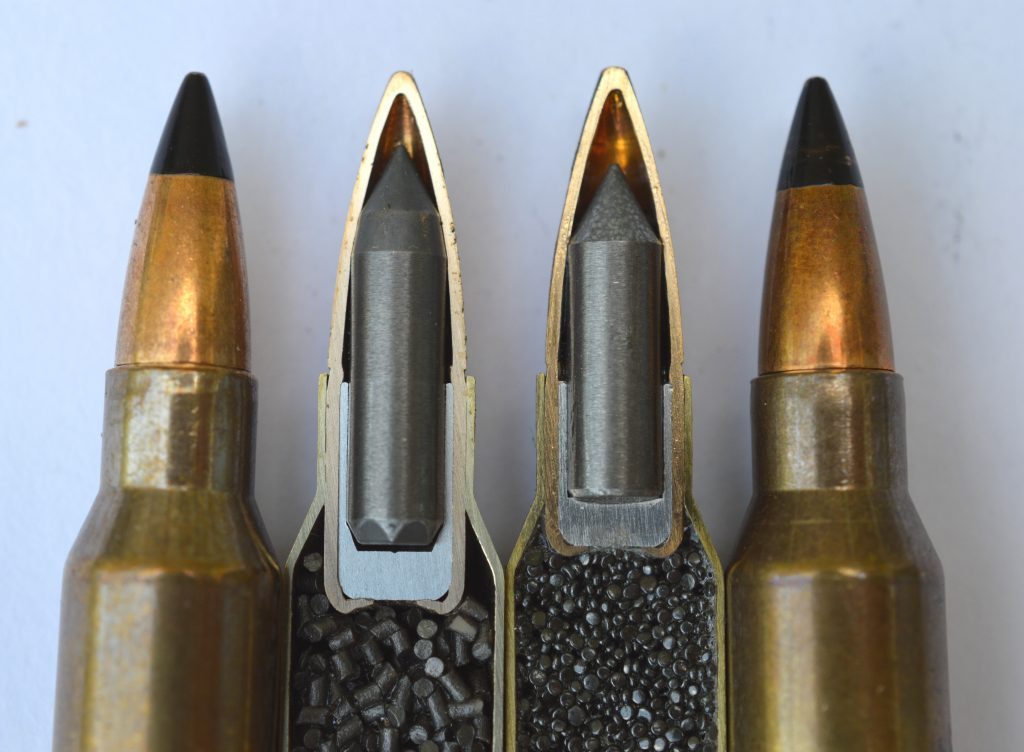
The M855, and the commercial loads modeled on it, have a green-painted tip. Inside the bullet is a small steel penetrator in front of a lead core. The military adopted it to improve penetration of hard targets such as steel at distance. That is a real advantage against hard barriers, but it comes with trade-offs that matter to civilians.
First, a bullet designed to penetrate does not expand the way a hunting or defensive bullet does. How much damage it does in soft tissue depends heavily on velocity and on whether the bullet yaws, or turns sideways, after impact, which makes its behavior less predictable than a bullet designed to expand. Second, the steel tip is hard on steel targets; many ranges ban steel-core and steel-tip ammunition because it damages steel plates and can raise sparks. Third, a bullet built to keep going through hard material will also keep going through walls.
| Example | What it is |
|---|---|
| Federal American Eagle XM855 | Federal's commercial version of the 62-grain M855 pattern. |
| Hornady Frontier M855-equivalent | A 62-grain load built to the M855 specification. |
| PMC X-TAC 62-grain green tip | PMC's M855-pattern load. |
So use green tip for what it was built to do, and check your range's rules before you bring it. For most civilian shooters it is a training round that happens to match a military load, not a defensive or hunting choice.
Common mistake: Assuming that more penetration is always better. A bullet built to drive through barriers is doing a different job than one built to expand and stay in the target. The next category exists because of that difference.
Defensive and duty loads: Predictable behavior on impact
When the stakes are higher, such as home defense or duty use, you want ammunition chosen for what the bullet does when it hits, not only for price or accuracy. Defensive rifle bullets are engineered either to expand and hold together, which drives deeper and suits shots through barriers such as car doors, or to expand rapidly and fragment, which tends to limit penetration in a person and in building materials. Over-penetration is a bullet passing through its target, or through walls, and continuing on.
That gives you the central trade-off for a defensive load. The features that let a bullet stay intact through a car door also let it travel farther through drywall. A load designed for patrol officers may not be the best choice for a family in a house with thin interior walls. Two common Hornady examples show the difference:
| Example | Designed for |
|---|---|
| Hornady TAP Barrier, 62 grain | Staying intact through barriers and then expanding in soft tissue, which suits patrol use. |
| Hornady TAP Urban, 55 grain (.223 Remington) | Rapid expansion and fragmentation, which tends to reduce penetration compared with barrier loads. |
| Bonded soft points, such as Federal Fusion MSR | A jacket and core joined so they stay together, giving deeper penetration than a fragmenting bullet. |
No rifle load guarantees that a bullet will stop inside a wall. The more important safety decisions are knowing your target and what is beyond it, choosing where you would stand and shoot in your own home, and practicing enough that your shots land where you intend. Whichever defensive load you choose, fire enough of it to confirm your rifle feeds it reliably and that it hits where your practice load hits. Our article on selecting personal and home defense ammunition goes further.
Match-grade loads for accuracy
Imagine two shooters with identical rifles and identical skill. One fires bulk ammunition, and the other fires match ammunition, and the second shooter's groups are smaller. The rifle did not change. The ammunition did. Match ammunition is built for consistency: Bullets that are nearly identical, and powder charges that keep the velocity spread, how much the speed varies from shot to shot, small. Consistent speed means each bullet follows nearly the same path.
A common accuracy measure is MOA, or minute of angle, which is about one inch at 100 yards; "sub-MOA" means groups smaller than that. Our article on understanding MOA explains how to use that measure. Match bullets are often heavy for the caliber, so the twist rate of your barrel matters here more than anywhere else.
| Example | What it is |
|---|---|
| Federal Gold Medal Match | Federal's match line, which in .223/5.56 has used Sierra MatchKing bullets such as the 69- and 77-grain weights. |
| Hornady Match | Hornady's match line, with loads such as the 73-grain ELD Match and 75-grain BTHP. |
Be honest about where you are. If your groups from a rest are much larger than the ammunition's potential, practice and a better trigger technique will improve them more than premium ammunition will. Match ammunition pays off when you can already shoot consistently and want the cartridge to stop being the limit. Our article on how ammunition affects your accuracy explains why consistency in the cartridge shows up on paper.
Hunting, varmint and frangible loads
The last group covers loads built for specific purposes, each with its own bullet design.
- Hunting bullets, such as soft points and bonded bullets, are designed to expand and hold together for a humane kill. Winchester's 64-grain Power-Point and Federal's Fusion MSR are common examples.
- Varmint bullets, such as Hornady's polymer-tipped V-MAX, are designed to expand violently in small animals. That is the right behavior on a prairie dog and the wrong behavior on a deer.
- Frangible rounds are made from compressed material designed to break apart on hard surfaces, which reduces ricochet and splash on steel targets at close range. Follow the steel target maker's minimum distances even with frangible ammunition.
A word about subsonic 5.56: bullets light enough for this cartridge carry little energy when slowed below the speed of sound, and many AR-15s will not cycle reliably with them. If quiet shooting is your goal, a cartridge designed for it, such as the .300 Blackout, is usually the better tool.
Before you hunt with any 5.56 load, check the rules where you hunt. In Iowa, for example, no .22-caliber centerfire rifle is legal for deer during the youth, disabled or shotgun seasons, because Iowa Code section 481A.48 limits rifles in those seasons to expanding bullets of .350 to .500 inch with at least 500 foot-pounds of muzzle energy. In Iowa, the 5.56 is a varmint and predator cartridge.
Matching the load to your rifle
Choosing the right 5.56mm ammunition is not just about the bullet. It is about matching the load to your rifle. Before any of that, make sure your chamber accepts 5.56 ammunition; the marking on the barrel tells you.
Barrel length and twist rate
Barrel length changes how much push the powder can give the bullet, so a short barrel gives up velocity. That matters most for bullets that need speed to expand or fragment, which can become less reliable from short barrels at longer distances. Published velocities are measured in a test barrel, often longer than yours.
Twist rate is how quickly the rifling, the spiral grooves in the barrel, spins the bullet. It is written as a ratio, so 1:7 means one full turn in 7 inches. That spin keeps the bullet stable, like the spiral on a well-thrown football, and longer, heavier bullets need a faster twist.
| Twist | Bullets it handles well |
|---|---|
| 1:7 or 1:8 | The full range, including heavy 68 to 77 grain match and hunting bullets |
| 1:9 | Light and medium bullets (55 to 62 grain); may struggle with the heaviest |
Start from your rifle. Find your twist rate, then go back to the categories above and look at the bullet weights. A 1:9 barrel matches the 55 to 62 grain training and green tip loads. The 77-grain match loads call for a 1:7 or 1:8 twist. See our barrel twist rate guide for more.
Good practice: Write your barrel length, twist rate and chamber marking on a card and keep it in your range bag. It takes the guesswork out of every ammunition purchase.
Suppressors and accessories
If you shoot suppressed, test your loads suppressed, because a suppressor can change point of impact and how hard the action cycles. Our article on choosing ammunition for suppressors adds more. An optic and a free-float handguard let you see the difference match ammunition makes; with iron sights and a heavy trigger, that difference may be hidden.
Choosing and confirming your loads
Your uses and your rifle together narrow the field. List what you do with the rifle in order of how often, such as range practice, varmints and home defense, alongside its barrel length, twist rate and chamber marking. Each use points to a category above, and the twist rate points to bullet weights that will stabilize. One box of each candidate, shot in three- to five-shot groups from a steady rest at your usual distance, with eye and ear protection and the muzzle downrange, shows group size and any malfunctions. Retesting on another day confirms the result, because conditions change it. The load that fits the job and that your rifle shoots well is your answer for that use.
Putting it together
Most AR-15 owners need two loads, not ten. One is an affordable training load that suits the twist rate and feeds reliably, which you buy in quantity. The other is a load chosen for the one job that matters most to you, whether that is defense, varmints or accuracy, which you test, zero with and keep enough of on hand. Green tip fills a narrow role, and match ammunition is worth its price once your shooting has caught up to it. Start with the job, check the rifle, compare a couple of candidates on paper, and let your own results, not the loudest opinion, decide.
Check your understanding
Try answering these before you open the answer. If you can decide what to do and explain why, you have it.
1. A friend keeps green tip M855 by the bed because "it goes through anything." Why isn't it automatically the best home-defense choice?
M855-pattern loads are built to penetrate hard targets. They don't expand like a defensive bullet, their effect in soft tissue depends heavily on velocity and yaw, and a bullet designed to keep going through hard material will also keep going through walls.
2. A friend wants the defensive load that is least likely to pass through interior walls. What do you tell them?
Loads designed to fragment, such as TAP Urban, tend to penetrate less than barrier loads, but no rifle load guarantees a bullet stops in a wall. Knowing your target and what is beyond it, and planning where you would shoot in your home, matter more than any box.
3. Your rifle has a 1:9 twist and you are tempted by a 77-grain match load. What should you check, and why?
A 1:9 twist handles 55 to 62 grain bullets well but may not stabilize the heaviest. A 1:7 or 1:8 twist is the better match for 77-grain bullets, so check your rifle maker's guidance and test before relying on it.
4. A deer hunter in another state plans to use 55-grain V-MAX varmint loads in his AR. What would you warn him about?
Varmint bullets are designed to expand violently in small animals. In a deer, that rapid fragmentation can mean shallow penetration that doesn't reach the vitals. He also needs to check that a .22 centerfire is legal for deer where he hunts; in Iowa's shotgun deer seasons, it isn't.
5. A friend says that buying a match-grade load guarantees tight groups from your AR-15. What else can affect the result?
Your skill, the trigger, the barrel's condition and twist, the optic, and the day's conditions all affect results. Test the load in your own rifle to see what it really does.
Where to go next
Once you know which category fits you, go deep on one maker. A Guide to Federal's 5.56mm Ammunition and A Complete Guide to Hornady's 5.56mm Ammunition walk through complete lineups line by line, so you can see how a single brand covers several of these jobs. If you want to know why consistency shows up on paper, How Ammunition Affects Your Accuracy is the natural next read. And if the defensive section is the one you care about, Selecting the Right Personal / Home Defense Ammunition goes further.
If this article helped you, we invite you to sign up for email notifications of new blog articles.