
General Considerations for .22 LR Ammunition Selection
Joseph McLain Nov 07, 2026
You have a new .22 rifle, and every box you look at says ".22 LR." Each will fit your chamber. Some cost a fraction of the others, some are labeled hyper velocity, subsonic or hollow point, and plenty of pistols won't run on cheap bulk ammunition. Why do boxes of the same cartridge behave so differently?
By the end you should be able to match a .22 LR load to your firearm and your purpose, know the major brands and their best-known lines, and find the load your own gun likes.
Why .22 LR is everywhere, and why the choice of load still matters
Since its introduction in the late 19th century, the .22 Long Rifle has become the go-to round for training, plinking, small-game hunting, competition shooting and introductory firearms. Its low cost, minimal noise and mild recoil make it unusually versatile, and those same traits explain the jobs it does well.
- Training and first firearms. Low recoil, low cost per round and a forgiving nature let new shooters fire many rounds, which is how skills get built.
- Plinking and recreation. Minimal noise and light recoil allow long sessions without fatigue or disturbing the environment.
- Small-game hunting. It is effective on small game such as rabbits and squirrels, with various bullet types optimized for ethical kills.
- Competition. Bullseye, steel challenge and NRL22 rely on the consistent performance and accuracy of well-tuned .22 LR ammunition.
The catch is that not all .22 ammunition is created equal. Differences in velocity, bullet construction and brand formulation significantly affect reliability and accuracy, and the effect changes with the barrel length of your rifle or pistol. A load that shines in a competition rifle can be a poor fit for a short-barreled pistol.
Key idea: Choose a .22 LR load by matching three things, your firearm type (rifle or pistol), the velocity you want (subsonic, standard, high or hyper) and the bullet design (lead round nose, copper-plated, hollow point and so on).
Velocity: How fast the bullet leaves, and what that does for you
Velocity is how fast the bullet is traveling, measured in feet per second (fps). It affects three things you will notice at the range. One is how loud the shot is, another is whether a semi-automatic cycles, and the third is how much energy arrives downrange. A bullet that travels faster than sound produces a sharp "sonic crack," and subsonic loads are designed to stay under that speed.
| Category | Typical speed | What it does | Where it is used |
|---|---|---|---|
| Subsonic | Under 1080 fps | Minimizes the sonic crack and is quieter, but may reduce bullet expansion in hunting | Suppressed .22 LR; some match and competition loads sit around 1070 fps |
| Standard velocity | About 1080 to 1120 fps | Balances recoil impulse and consistent accuracy; good cycling in both rifles and pistols | Common in competition loads |
| High velocity | About 1200 to 1300 fps | Ensures proper cycling in semi-automatic firearms and gives more energy downrange | The most popular general-purpose range and hunting ammunition |
| Hyper velocity | Over 1400 fps | Typically uses lighter bullets (32 to 36 grains) for more speed; may produce more muzzle blast and sometimes feed issues in certain firearms | Examples include CCI Stinger (about 1640 fps), CCI Velocitor and Remington Yellow Jacket |
These are trade-offs, not a ladder where faster is better. The boundaries also overlap. A match load at about 1070 fps sits right at the edge between subsonic and standard, so think of these as neighborhoods instead of fences.
The reason velocity affects cycling is simple. A semi-automatic .22 runs on the energy of the cartridge itself, because the burst of gas pushes the action back to eject the empty case and load the next one. A very gentle load may not push hard enough, and a very hot one can add muzzle blast and sometimes feed issues. High velocity lands in the middle, which is why it is the everyday choice. The same trade shows up for hunters, since high-velocity loads deliver more energy downrange while a quiet subsonic load may reduce expansion.
Bullet types: What is on the front of the case
The second choice is the bullet itself. Each design solves a different problem.
- Lead round nose (LRN). The simplest form, made of uncoated lead and common in standard or subsonic loads. It is known for decent accuracy but can increase barrel fouling.
- Copper-plated (CPRN, CPHP). A lead core with a thin copper plating that reduces barrel fouling and minimizes lead exposure. These are frequently found in high-velocity or bulk-box range ammunition.
- Hollow point (HP). Designed for small-game hunting and defensive applications, hollow points expand on impact to maximize terminal performance.
- Polymer-tipped. Rare in .22 LR, these bullets slightly improve the ballistic coefficient and help expansion, though they are more common in centerfire ammunition.
Most of the time the choice is simple. Copper-plated bullets are the practical workhorse for high-volume shooting because they keep the barrel cleaner, hollow points are for hunting, and lead round nose is the classic standard-velocity choice. You can read how plating and exposed lead change fouling and lead exposure in our guide to FMJ and TMJ bullets.
How your firearm changes the answer
The same load behaves differently in different guns, largely because of barrel length. A longer barrel gives the powder more time to burn and push, much as a longer runway lets an airplane reach higher speed. A short barrel gives it less time, so velocity falls.
- Rifle with a long barrel (16 to 20 inches). A longer barrel enhances the velocity of high- and hyper-velocity loads such as CCI Stinger or Remington Yellow Jacket by allowing more complete powder burn. For target or competition, standard or match-velocity loads such as Federal Gold Medal or CCI Standard are ideal, and for small game or casual plinking, high-velocity loads work well.
- Pistol with a short barrel (such as 4 to 6 inches). Short barrels typically reduce muzzle velocity by 100 to 200 fps, which can affect accuracy and expansion. High- or hyper-velocity loads can help maintain reliable cycling in blowback pistols (pistols whose slide is held shut only by spring pressure and its own weight), though standard or match-velocity loads may be preferable for dedicated competition pistols.
- Compensated or scoped firearms. A compensator is a muzzle device that redirects gas to tame muzzle movement. For rifles or pistols with compensators or scopes, choose ammunition with tight velocity spreads, such as Federal Gold Medal Rimfire or CCI Standard, to maximize precision. Top-tier match loads often perform best in these setups.
- Suppressor-ready platforms. Subsonic ammunition is a must to minimize the sonic crack, and CCI Quiet-22 and Remington Subsonic are examples. Some suppressed ammunition, like the standard CCI Quiet-22, may not cycle well in semi-automatic firearms, so test compatibility carefully.
The pattern across all four is that each setup rewards a different priority. Pistols need cycling, optics and compensators need consistency, and suppressors need low speed. A velocity spread is how much the speed varies from shot to shot, and a tight one means every bullet drops about the same amount, which matters most when you are aiming through a scope. Our article on how ammunition affects accuracy explains why consistent velocity tightens groups. If you plan to shoot suppressed, Choosing the Right Ammunition for Suppressors goes further.
The major brands and what each one is known for
Experienced shooters often turn to CCI, Federal, Remington and Winchester for .22 LR. (Hornady is a major rimfire name too, but its rimfire line centers on .17 HMR, .17 Mach 2 and .22 WMR rather than .22 LR.) Each brand has a character, and once you know it, the name on a box starts telling you something.
CCI
CCI is known for rimfire reliability and consistent ignition. Its range spans from very quiet to hyper velocity, and our guide to CCI's .22 product line covers it in depth.
- CCI Standard Velocity. About 1070 fps and often used in match or target contexts, with minimal recoil that suits small-bore competitions.
- CCI Mini-Mag. About 1235 fps with 36- or 40-grain bullets (often copper-plated HP or LRN), revered for semi-automatic reliability and decent expansion on small game.
- CCI Stinger. A hyper-velocity load (about 1640 fps) with a 32-grain hollow point, excellent for varmint control. Some firearms may prefer standard-length ammunition because of the Stinger's slightly longer brass.
- CCI Quiet-22. A subsonic load (about 710 fps) designed for extremely quiet shooting and ideal for suppressed setups, though it generally will not cycle a semi-automatic. CCI also makes a Quiet-22 Semi-Auto version loaded to cycle many semi-automatics, which is worth testing if you want quiet shooting in a self-loading rifle.
Federal
Federal is known for a wide variety of offerings, from budget-friendly bulk loads to premium match-grade ammunition. The lineup shows the trade-off clearly.
- Federal Champion / AutoMatch. Bulk packs in high or standard velocity with LRN or CPRN bullets, suitable for high-volume training with moderate accuracy.
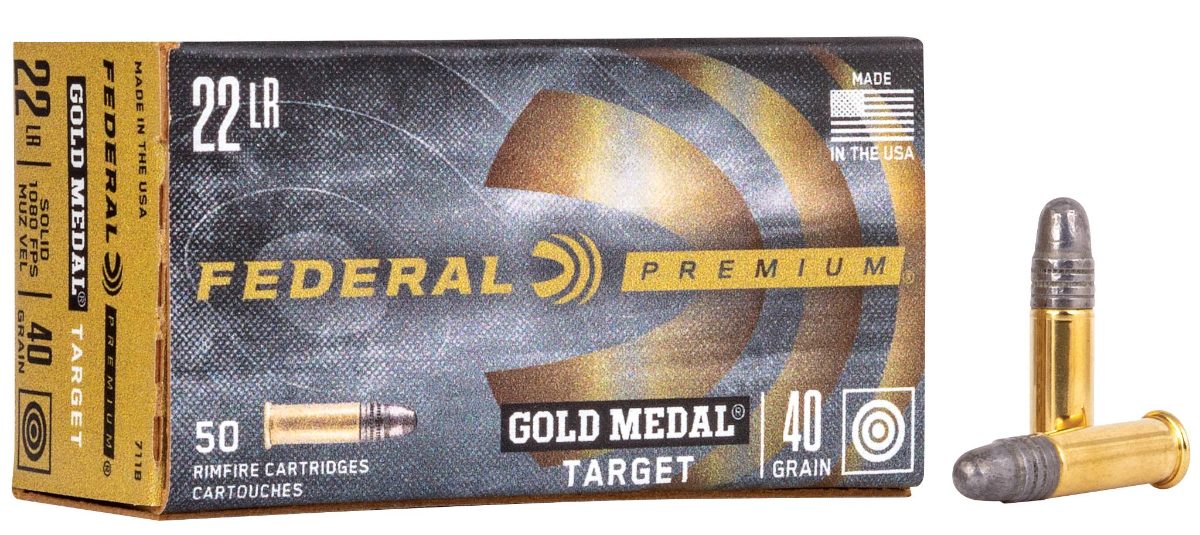
- Federal Gold Medal Rimfire. A premium line with tight velocity spreads, often used in formal rimfire competitions that require match-grade consistency.
- American Eagle. A dependable, budget-friendly option with 38- to 40-grain high-velocity loads, well suited to everyday plinking and practice.
Remington
Remington is known for classic .22 LR lines such as Golden Bullet and for specialized high- and hyper-velocity loads.
- Remington Golden Bullet. A classic bulk high-velocity load featuring 36- or 40-grain plated lead bullets. Modern production has improved reliability compared to older lots.
- Remington Thunderbolt. An LRN high-velocity load popular in high-volume "bucket" packages. It is cost-effective but may require careful cycling in some firearms.
- Remington Subsonic. A subsonic hollow point load for quiet shooting or suppressed applications. (Remington's Cyclone, by contrast, is a high-velocity hollow point.)
Winchester
Winchester is known for its long-running Super-X brand and a wide variety of .22 LR offerings.
- Winchester Super-X. Available in high-velocity and subsonic versions with 36- to 40-grain configurations, typically using hollow point or round nose bullets.
- Winchester M-22. Marketed for AR-style .22 LR rifles, with black copper-plated round nose bullets, and sold in large bulk packs.
- Winchester Wildcat. A budget high-velocity load known for its affordability, though it may not be as consistently accurate as premium lines.
Across these brands the same story repeats. Bulk lines such as Champion, Golden Bullet, Thunderbolt, M-22 and Wildcat are built for volume and low cost, and a few come with caveats about accuracy or cycling. Match lines such as Gold Medal and CCI Standard are the choice when consistency matters most.
From goal to load: Where to start
| Your goal | Loads to start with | Why |
|---|---|---|
| Match-level accuracy | Federal Gold Medal Rimfire or CCI Standard | Suited to shooters aiming for sub-MOA groupings (smaller than about one inch at 100 yards) on the bench or in competition |
| General plinking and high-volume range use | CCI Mini-Mag, Winchester Super-X or Federal American Eagle | Reliable cycling, good accuracy and a cost-effective solution for everyday shooting |
| Small game and varmint control | CCI Stinger or Remington Yellow Jacket | When extra velocity is needed for more terminal performance on small game, these hyper-velocity loads can deliver |
| Suppressed shooting | CCI Quiet-22 (or Quiet-22 Semi-Auto) or Remington Subsonic | Noise reduction is critical and the sonic signature is minimal; test cycling if you shoot a semi-automatic |
Treat these as starting points and not final answers. Each row pairs a goal with the load character that serves it, and your own firearm gets the last word, which is what the test below is for.
Common mistake: Assuming faster is better, or that one load will suit every firearm. Hyper velocity can bring more muzzle blast and feed issues, and a quiet load may not cycle a semi-automatic. Match the load to the firearm and the job.
A three-load test for your own firearm
Trying different brands and bullet weights is the surest way to find the load that gives the best accuracy and cycling in your setup. Choose three loads for what you do, such as a standard-velocity or match load, a bulk high-velocity load and, if you hunt, a high-velocity hollow point. With eye and ear protection on and the muzzle downrange, shoot a five-shot group with each from a rest, noting group sizes and, in a semi-automatic, any failure to feed or eject. If you shoot suppressed, add a subsonic load and see whether the action cycles. The load with the best groups that cycles reliably is your keeper; one that fails more than once is not.
Putting it together
Every box says .22 LR, but each was built around a different trade between speed, sound, bullet and price. A pistol that won't run on cheap bulk ammunition is a real example: Some blowback pistols need the extra push of a high-velocity load, while some rifles group best with gentle standard-velocity match ammunition. Start with your firearm and your job. For practice in a semi-automatic, try two or three high-velocity bulk loads and keep the one that cycles every time. For accuracy, try standard-velocity and match loads. For small game, use a hollow point and keep your shots close, and remember that a .22 LR bullet can travel more than a mile, so a safe backstop matters as much with a .22 as with a deer rifle. The rimfire is legal for small game in Iowa but not for deer. Then let a test in your own gun decide, because it has the final say.
Check your understanding
Try answering these before you open the answer. If you can decide what to do and explain why, you have it.
1. Your semi-automatic .22 rifle will not cycle with CCI Quiet-22. Why, and what could you try?
Quiet-22 is a subsonic load at about 710 fps, so it usually does not supply enough energy to cycle a semi-automatic action. Try CCI's Quiet-22 Semi-Auto version, or accept manually cycling the rifle when you want maximum quiet.
2. You've started shooting NRL22 matches with bulk high-velocity ammo, and your groups are inconsistent. Why might standard-velocity or match ammunition help?
Standard-velocity and match loads balance recoil impulse with consistency, and match lines have tight velocity spreads, so each bullet drops about the same amount. That consistency matters in precision disciplines like bullseye and NRL22.
3. After a day of plinking with lead round nose, your barrel is noticeably dirtier than with copper-plated bulk ammo. Why?
Lead round nose is uncoated lead, which leaves more fouling in the bore. Copper-plated bullets have a thin plating over the lead core that reduces fouling and lead exposure, which is why they're common in bulk range ammunition.
4. You have a pistol with a 4 to 6 inch barrel. How does that affect your ammunition choice?
Short barrels typically reduce muzzle velocity by 100 to 200 fps, which can affect accuracy and expansion. High- or hyper-velocity loads can help maintain reliable cycling in blowback pistols, though standard or match-velocity loads may be better for a dedicated competition pistol.
5. You plan to add a suppressor to a .22 rifle. Which velocity class should you pick, and what should you test?
Subsonic, to minimize the sonic crack. Test cycling in a semi-automatic, because some suppressed ammunition may not cycle well.
Where to go next
If you are newer to the cartridge, start with why the .22 LR is such an ideal firearm for building and refining shooting skills, which shows how the ammunition you chose gets put to work. If you are still choosing the gun itself, Choosing the Right .22 Caliber Rifle will help you pick a platform for these loads. For the bigger picture of how this cartridge compares with others, read Rimfire vs. Centerfire Cartridges, and if a pistol is on your list, The Browning Buck Mark Line of Pistols shows these ammunition choices in a proven .22 pistol.
If this article helped you, we invite you to sign up for email notifications of new blog articles.